
Table of Contents
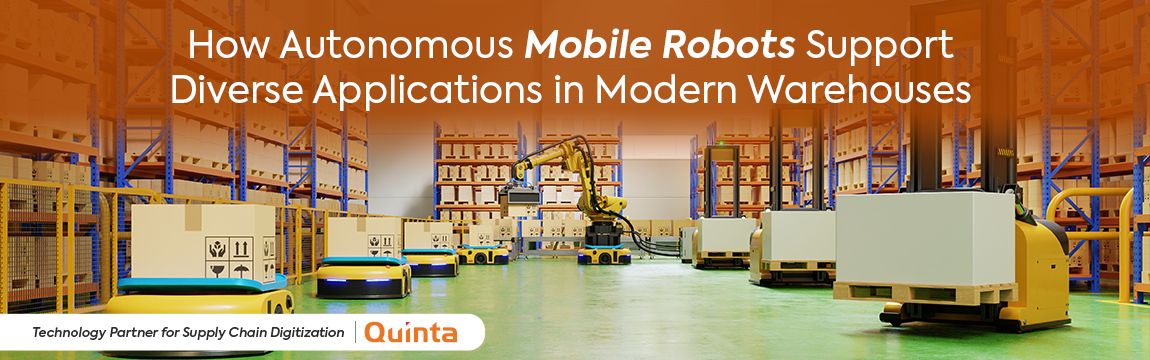
How Autonomous Mobile Robots Support Diverse Applications in Modern Warehouses
Arguably the biggest e-commerce marketplace, Amazon has become a trend-setter beyond its core operations. The company has emerged as a pioneer in strategic models and technology adoptions. Over the years, these practices have been widely emulated across industries. Hence, the giant’s announcements often indicate shifts in the market.
2025 was one such year, when all eyes were on Amazon.
Last year, Amazon’s robotics efforts—a major point of interest in the market, since 2012— hit a new milestone. The millionth robot in Amazon’s Autonomous Mobile Robots (AMRs) fleet, across 300 fulfilment centres worldwide, was deployed. Moreover, the organisation launched a new generative AI foundation model, which is designed for robotic fleet management.
A defining factor of the model is its capability of boosting intralogistics speed by 10%, thereby improving the efficiency of the overall order fulfilment process throughout the supply chain.
Introduction: What Does This Landmark Development in the Warehouse Automation Solutions Market Tell Us?
This industry news should serve as a clarion call for countries, such as India, which are focused on pumping fresh blood into their booming manufacturing sectors. In 2026, a new battle for capturing market share begins, and the winners will have a common arrow in their quivers: investment in material-handling automation.
Are you a key decision-maker or C-suite member in the warehousing, 3PL, e-commerce, and manufacturing industry? If so, this blog is like one of Quinta’s critical guidebooks for you to navigate 2026! Keep reading to learn about the massive scope for robotics-led material-handling applications in these operations and align your organisation with the evolving market.
It is worth noting that while we focus on modern warehouses in this piece, the applications remain the same in analogous workflow processes in other domains.
Let’s get started!
Different Applications of AMRs in Robotic Warehouse Systems Why Are Mobile Robots in Warehousing the Rage?
Equipped with cutting-edge technologies such as the anti-collision LiDAR (Light Detection and Ranging) technology and the surrounding-mapping process known as SLAM (Simultaneous Localisation and Mapping), AMRs have proven to be the ideal workforce in this age of Industry 4.0.
What Are Some of the Core Applications Autonomous Mobile Robots (AMRs) Support?
Heavy-Lifting
A major challenge when it comes to massive loads, such as pallets, is that employees in such strenuous processes risk their safety. Hence, the lifting, docking, shelving, and internal transportation performed by AMRs is not just a productivity driver but a safety measure.
At the same time, these mobile robots in warehousing and other scenarios can serve as an alternative to conveyor systems, which occupy massive square footage. The autonomous material-handling devices help uphold efficiency despite space constraints.
Inventory Management
AMRs in robotic warehouse systems are driven by WMS-WCS software suites. Combined with its mapping and anti-collision mechanisms, the robots can effortlessly navigate dynamic warehouse floors. As a redundancy step, the warehouse automation solution often has EoAT (End-Of-Arm Tooling) devices, including clasps or hand-like contraptions for picking and RFID/ barcode scanners for shipment identification.
Thanks to the robots, warehouse managers can frequently conduct inventory audits. This is because other aspects of inventory management, such as inventory tracking and logging, are simplified by leveraging other automation solutions within the ecosystem. Needless to say, robotic warehouse systems are not limited by AMRs. They also include DWS (Dimensioning, Weighing, and Scanning) machines and automated sortation systems. These solutions set the ground for inventory tracking and inbound shipment reconciliation.
Optimising Shipment Processing and Sorting
DWS and auto-sortation systems, often integrated into a continuous setup, are used to determine/verify the volumetric weight of the shipments and the label-encoded shipment ID, which primarily encrypts the shipments’ destination, among other details. However, smoothly docking the packages onto these automation solutions can be laborious and time-consuming. That’s where AMRs, including Conveyor Mobile Robots and Autonomous Forklifts, save the day.
Similarly, picking the shipments after sortation is intensive. Hence, AMRs can follow the lights or digital displays in the put-to-light system to reach the shelves designated by the WMS software. Apart from Forklift Mobile Robots (FMRs, also known as Autonomous Forklifts), Carton Transfer Units (CTUs) participate in this workflow.
Storage and Retrieval
Hand or prong-like holders of the WMS-guided AMRs, including FMRs and CTUs, facilitate placing shipments on the shelves as well as taking them off the storage unit. A key point to be noted here is that AMR-driven inventory management also accounts for shelf space optimisation.
G2P (Good-to-Person), Reverse Logistics, and Cobot Use Cases
In semi-automated tech suites or in workflows, where end-to-end automation is difficult to implement, AMRs minimise human labour by carrying the load between workstations or working alongside employees as they pick objects off shelves.
A key example of G2P is the internal shipment transportation stretch between the packing station and the workflow preceding the packaging process. Similarly, G2P can also be witnessed when returned shipments are processed and stored again by AMRs.
Cleanroom Scenarios
In cold supply chain warehouses, a key concern is preventing contamination or disturbance in temperature. Both these factors are jeopardised with human operators. However, mobile robots in warehousing infrastructure with cold storage facilities can help tackle this challenge. Usually, robotic warehouse systems are functional even in extreme temperatures, and it goes without saying that ensuring sterilisation with AMRs is easier than doing so with human operators.
How to Select Robotic Warehouse Systems' Material-Handling Solutions? Applications by Types of Autonomous Mobile Robots
The table below represents use cases of AMRs for warehouse automation and can help decision-makers opt for the right robot.
| Different AMRs in Warehouse Automation Solutions Suites | Payload Type | Use Case |
| FMRs & Conveyor Mobile Robots | Heavy (pallets and when several totes are grouped) | G2P, docking |
| CTUs | Medium/ light shipments | G2P, storage, retrieval, docking |
| AMRs with EoAT | Individual Objects | Picking and manual sorting are performed by robots |
What Are the Benefits of Embracing Autonomous Mobile Robots in Warehouse Automation Solutions Suites?
Here is a snapshot of the advantages of implementing mobile robots in warehousing:
- 24/7 Productivity
- Reduced Overhead Cost
- Improved Working Conditions and Safety
- Intuitive Human-Machine Interaction
- Effortless Scalability without Labour Coordination Efforts
- Increased Throughput
- Versatile Usability, i.e., Improved Adaptability
Operations managers should note that when robotics warehouse systems see greater throughput, their implications are:
- More Net Shipments Processed
- Greater Profitability
- Increased Competitiveness
- Swift Automation Investment Recovery
Why Opt for Quinta for Implementing Autonomous Mobile Robot Fleets in Your Robotic Warehouse System?
Warehouse Automation Solutions Used Right
Quinta has been at the forefront of modernising warehouse and manufacturing solution suites for several years. In this growing market, we stand out thanks to our holistic capabilities, which start with consulting and generating project blueprints for the problem given and extend to solution engineering, expert-driven hardware-software integration, installation, and lifecycle management support.
With Robotics as one of our specialisations, we are confident in helping you navigate the market changes, characterised by the deployment of AMRs and other warehouse automation solutions, which will emerge as a marker of success, future-readiness, efficiency, and world-class service.
Curious to know more? Contact us now and begin upgrading your legacy tech suite or semi-automated ecosystem into a state-of-the-art facility!

