
Table of Contents
What Is a Swivel Wheel Sorter and When Should You Use It in Warehouse Automation?

Warehouse Automation Specialist, Quinta
Last Updated: September 23, 2026
As the evening dawns at your e-commerce center, a mountain of parcels is heading for the loading docks.
Workers are rushing, errors are climbing, and shipping trucks are about to leave without your packages.
This daily bottleneck is where a swivel wheel sorter changes the game.
A swivel wheel sorter is a type of automated sortation system. It uses a line of motorized wheels embedded directly inside a conveyor belt.
When a parcel reaches the divert point, the wheels pivot left or right to steer it onto the required track.
In this guide, you’ll learn how a swivel wheel sorter works, where it fits in warehouse automation, how it compares with a cross-belt sorter, and what to consider before selecting a system.
What We Cover in This Article?
| Section | What You Will Learn |
|---|---|
| What Is a Swivel Wheel Sorter? | Understand what a swivel wheel sorter is and how it fits into automated warehouse sorting. |
| How It Works | Learn how swivel wheels, sensors, and conveyor controls work together to divert parcels. |
| Where Should You Use It? | Identify the warehouse, e-commerce, 3PL, and logistics operations where this sorting system is suitable. |
| Operational Sweet Spot | Understand the throughput, parcel types, and layout conditions where a swivel wheel sorter makes sense. |
| Swivel Wheel vs. Cross-Belt | Compare the two sortation systems based on application, flexibility, space, and operational requirements. |
| Key Benefits | Explore the advantages of swivel wheel sorting for multi-path parcel handling. |
| Planning & Layout Considerations | Learn what to consider when planning floor space, conveyor paths, divert points, and system integration. |
| When Should You Choose It? | A practical checklist to help determine whether a swivel wheel sorter is suitable for your operation. |
How Does a Swivel Wheel Sorter Work?
The sorting process begins when a parcel enters the conveyor and is identified by the system. Parcel detection and barcode scanning provide the information needed to determine its destination.
Once the destination is identified, the control system sends the required sorting command. As the parcel reaches the divert point, the swivel wheels pivot left or right to move it onto the correct conveyor path, lane, or chute.
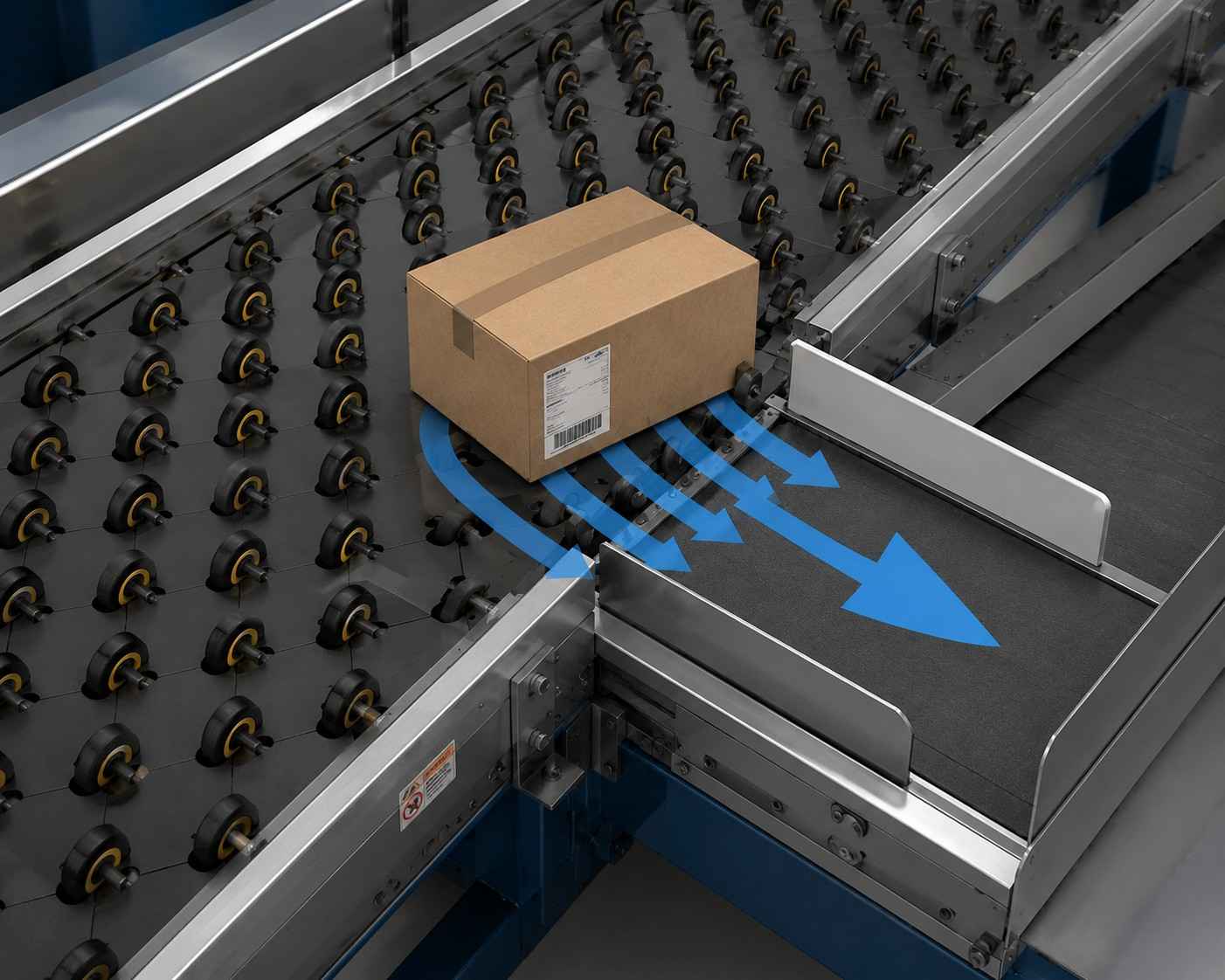
The system typically combines:
- Conveyor and swivel-wheel divert modules
- Parcel detection and barcode scanning
- Control software
- Destination logic
- Downstream conveyors or sort lanes
A swivel wheel sorter can handle 6,000–8,000 parcels per hour (PPH), depending on the system configuration and operating conditions.
How the Sortation Flow Works?
- Scan: An inline scanner reads the parcel barcode.
- Identify: The control system determines the required destination.
- Divert: Motorized wheels pivot to move the parcel onto the selected path.
- Exception handling: Unreadable or otherwise unassigned parcels can be routed to a dedicated exception lane.
When Should You Use a Swivel Wheel Sorter?
A swivel wheel sorter can be a good fit when your warehouse needs automated parcel diversion across multiple destinations while making efficient use of the conveyor layout.
Common Applications
- Polybags and Small Cartons: Suitable for compatible cardboard boxes, polybags and other parcels that meet the system’s size, weight and handling requirements.
- Diverse Packaging Mix: Can support operations handling different parcel sizes, weights and packaging types, provided they fall within the system’s operating specifications.
- Space-Constrained Floors: Its conveyor-integrated design can be considered when available floor space is limited and multiple sorting paths are required.
- Multiple Destinations: Useful when parcels need to be automatically diverted to different lanes, chutes or conveyor paths.
- Growing Parcel Operations: Can help automate sorting as parcel volumes and the number of destinations increase.
Swivel Wheel Sorter Vs Cross-Belt Sorter
Swivel wheel and cross-belt sorters use different mechanisms and can address different operating requirements.
| Factor | Swivel Wheel Sorter | Cross-Belt Sorter |
|---|---|---|
| Typical Throughput | 6,000–8,000 parcels/hour | 20,000–24,000 parcels/hour |
| Sorting Method | Rotating wheels divert parcels into different paths. | Individual belt carriers move parcels to designated destinations. |
| Footprint | Compact and can be integrated into conveyor lines. | Generally requires a larger dedicated system footprint. |
| Best Fit | Multi-path parcel diversion where compact integration is important. | Higher-volume sorting with multiple destinations. |
| Integration | Can be integrated at selected points in a conveyor line. | Typically designed as a larger automated sorting system. |
| Configuration | Modular divert points can support different conveyor layouts. | Designed around a larger automated sorting architecture. |
How to Compare Sorter Suppliers Before an RFQ?
Before requesting a quotation, prepare the operating data that determines sorter suitability.
A supplier should be able to explain how its proposed configuration handles your actual parcel profile and peak demand.
- What is the average and peak parcels-per-hour requirement?
- What are the minimum and maximum parcel dimensions and weights?
- What percentage of parcels are polybags, cartons or irregular packages?
- How many destinations or sort lanes are required?
- What barcode, scanner and WCS requirements apply?
- What happens to unreadable or failed-to-divert parcels?
- Can the sorter be integrated with the existing conveyor and controls?
- What maintenance access, spare parts and service support are included?
- What throughput and sort accuracy will the supplier guarantee for the proposed configuration?
- What are the expected expansion options if parcel volume increases?
Integrating a Wheel Sorter for True Logistics Automation
Many warehouse operators worry that adding a sorter means replacing the entire conveyor setup. A modular integration strategy can instead place divert units at selected junctions within an existing line, subject to a site and engineering assessment.
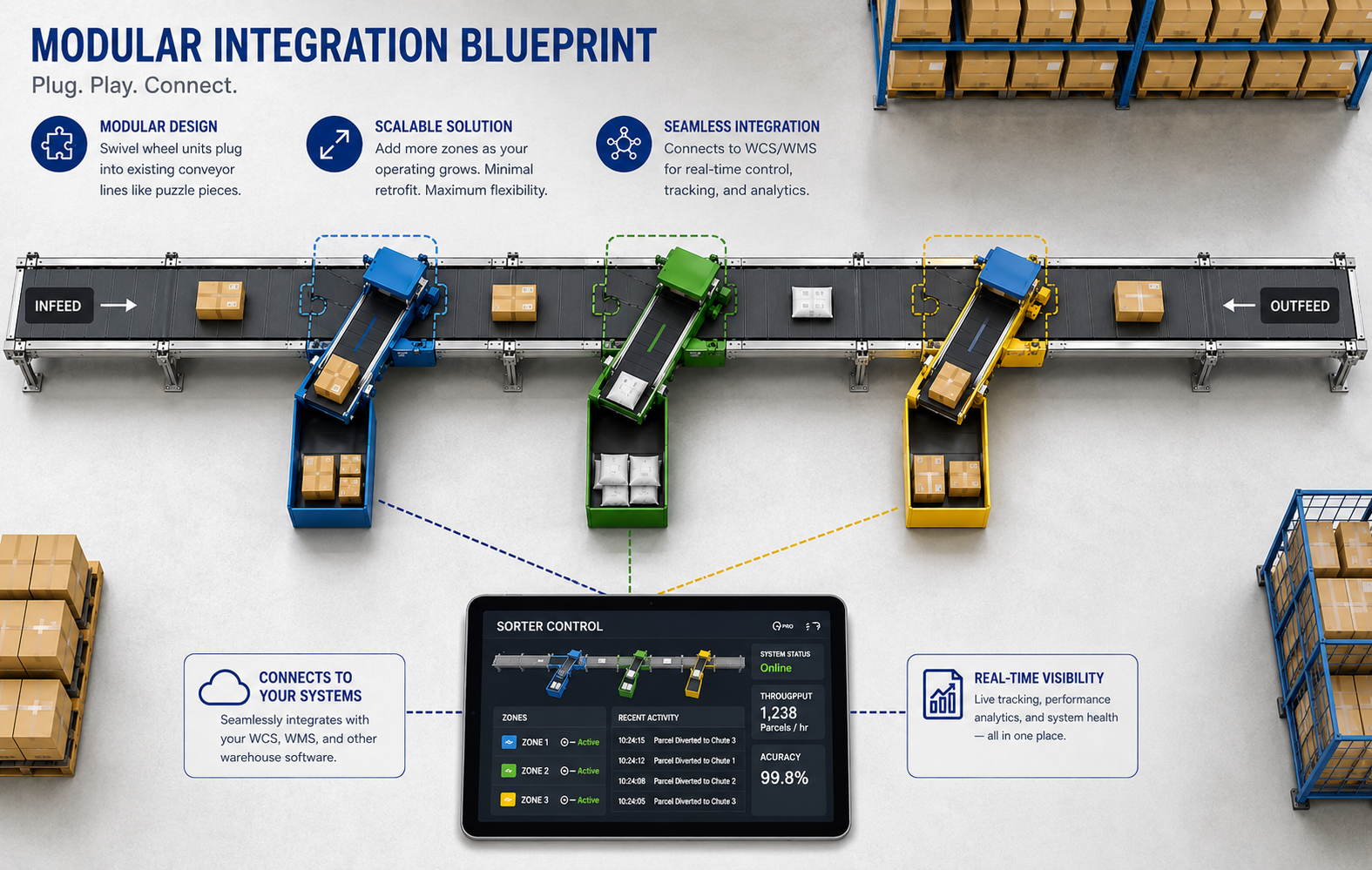
The objective is to automate key decision points, reduce unnecessary manual walking and keep the floor organized. Whether an existing conveyor can be reused depends on its mechanical design, controls, dimensions, load requirements and the proposed wheel-sorter unit.
How to Choose the Right Swivel Wheel Sorter?
Before requesting a quotation, prepare the operating information that determines whether the system is suitable for your facility.
1. Throughput
Define:
- Average parcels per hour
- Peak parcels per hour
- Required future capacity
2. Parcel Profile
Document:
- Minimum and maximum dimensions
- Parcel weight
- Cartons vs. polybags
- Irregular packages
- Parcel orientation
- Package stability
3. Number of Destinations
Determine the number of:
- Sort lanes
- Chutes
- Conveyor destinations
- Divert points
4. Existing Conveyor
Check whether the proposed sorter can integrate with:
- Existing conveyor equipment
- Scanners
- Sensors
- Controls
- WCS
- Electrical infrastructure
5. Future Expansion
Consider whether the system can accommodate additional destinations or divert points if parcel volumes increase.
Benefits of a Swivel Wheel Sorter
Depending on the application and configuration, a swivel wheel sorter can provide:
- Automated parcel diversion
- Multi-path sorting
- Compact conveyor integration
- Modular configuration
- Support for mixed parcel flows
- Reduced manual intervention at sorting points
- Potential for phased expansion
The actual benefit depends on the facility’s parcel profile, throughput, layout and automation requirements.
Why Choose Quinta for Swivel Wheel Sortation?
Quinta provides Intralogistics automation and Warehouse Automation Consulting services designed around specific warehouse and logistics requirements.
For a swivel wheel sorter project, the system should be evaluated based on your parcel profile, required throughput, number of destinations, available space, conveyor layout, and integration requirements.
If you’re planning a new automated sorting system or evaluating an existing conveyor line, Quinta’s team can help assess the appropriate configuration for your operation.
Frequently Asked Questions About Swivel Wheel Sorters
A swivel wheel sorter is a type of automated sortation system that uses motorized wheels to divert parcels from a conveyor into different paths.
It is used to automate parcel diversion at selected points in a conveyor system, particularly where compact, modular sortation is required.
2,000–4,000 parcels per hour. Actual capacity depends on the configuration and parcel profile.
They are different technologies with different application envelopes. Selection should be based on throughput, parcel characteristics, destinations, footprint, integration and cost rather than a universal ranking.
Potentially. Retrofit feasibility depends on the existing conveyor's mechanical and control design and should be confirmed through an engineering assessment.
Cost varies by configuration, throughput, controls, integration, installation and service requirements, so a project-specific quotation is needed.
They can be routed to an exception lane for manual handling, depending on the configured scanning and control system.
Compare verified throughput, parcel range, sort accuracy, integration capability, maintenance support, spare-parts availability, service coverage, expansion options and project references.
Possible causes include barcode/scanner issues, induction timing, parcel characteristics outside the designed envelope, controls configuration and mechanical issues.
It can handle appropriately packaged fragile products, but unboxed fragile items should not be assumed to be suitable.
References
About Author
Stephen Athokpam is a Warehouse Automation Specialist at Quinta, covering high-speed sortation systems, material handling tech, and distribution center optimization.
Stephen Athokpam is a Warehouse Automation Specialist at Quinta, covering high-speed sortation systems, material handling tech, and distribution center optimization.

