
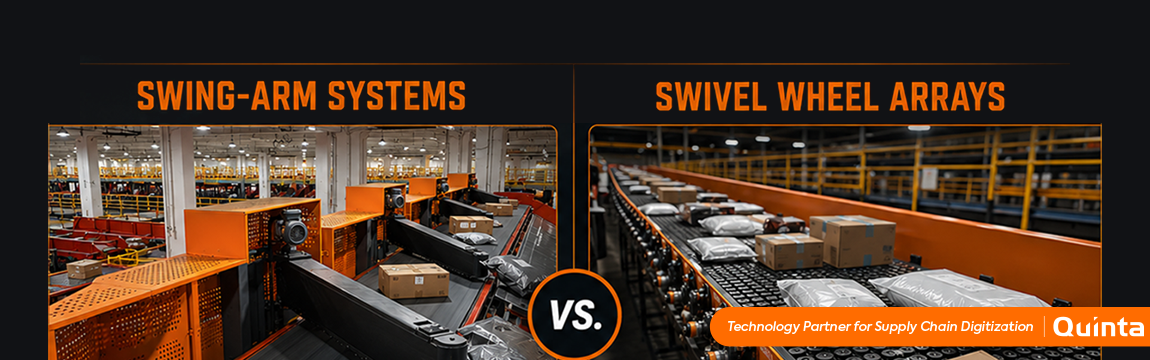
Swing-Arm Sorter vs Swivel Wheel Sorter: Key Differences & Use Cases
Table of Contents
If Sorting were art, Sorters would be Mozart…or Salieri, depending on which side you lean.
And so, when it comes to choosing the right sorting system, you can either choose the Mozart of Sorters (the Swing-Arm Sorter) or the Salieri (Swivel Wheel Sorter).
Remember:
There is no wrong choice, just different options based on your requirements.
Today, we will compare these two popular options.
We will use simple, real-world examples to explain them, and hopefully by the end, you will know exactly which one fits your warehouse.
What is a Swing-arm Sorter?

Think of a swing-arm sorter like a traffic cop. The cop stands at an intersection and points cars toward different roads.
In a warehouse, a mechanical arm sits beside the main conveyor belt. When a package arrives, the arm swings out across the belt.
It physically pushes the package onto a new path or chute. Once the package passes, the arm quickly swings back into place.
A Real-World Example
Imagine sorting heavy plastic crates filled with tools. The crates are tough and can handle a physical push.
The swing-arm acts like a gate opening and closing. It safely deflects each heavy crate to the correct shipping lane.
What is a Swivel Wheel Sorter?

Now, picture a skateboarder smoothly changing lanes on a street. They do not get pushed; they just change their wheel direction.
A swivel wheel sorter uses rows of small wheels embedded inside the conveyor. These wheels normally spin forward to keep packages moving straight.
When a package needs to turn, the wheels instantly pivot sideways. They guide the package smoothly onto a new line without hitting it.
A Real-World Example
Imagine sorting fragile cardboard boxes containing glass jars. A hard push from a metal arm might break the glass inside.
Instead, the sorting wheels gently redirect the box. The box changes direction smoothly, keeping the contents safe.
Not sure which system fits your facility? Our warehouse automation
Consultants can assess your throughput, product mix, and floor layout.
Breaking Down the Key Differences Between Swivel Sorter and Swing-arm Sorters.
To choose the right tool, you must understand its core mechanics. Here is how they stack up against each other.
Feature | Swing-arm Sorter | Swivel /Slanting Wheel Sorter |
Sorting Action | Direct physical push | Smooth wheel redirection |
Impact Level | High impact | Very low impact |
Sorting Speed | Moderate speed | High speed |
Best Product Type | Rigid, tough items | Fragile items, polybags |
Where Does Each Sorter Belong?
Every warehouse has unique daily operational needs. Let us look at where these logistics systems for bale arms truly shine.
The swing-arm Sorter Warehouse
This system belongs in facilities handling heavy or uniform goods. It is perfect for industrial parts, plastic totes, and durable boxes.
If your products can take a hit, this is a budget-friendly choice. It is highly reliable for low-to-medium throughput environments.
The Swivel Wheel Sorter Warehouse
Swivel System belongs to modern e-commerce and logistics hubs. It is ideal for handling mixed parcels, polybags, and fragile items.
If you sort diverse shapes and sizes, choose swivel wheels. It keeps high-velocity lines moving fast without causing product damage.
Performance Comparison
Throughput and product handling define your daily efficiency. Let us compare their operational capabilities.
Operational Metric | Swivel Wheel Sorter | |
Throughput Capacity | 30 to 60 parcels per minute | Up to 100+ parcels per minute |
Product Variety | Limited to rigid items | High (boxes, envelopes, bags) |
Maintenance Needs | Low (simple mechanical parts) | Medium (multiple moving wheels) |
Floor Space Required | Small footprint | Requires integration into lines |
In Case You Have Some Questions
The swing-arm sorter is significantly cheaper to purchase and install. Its simple mechanical design requires fewer sensors and motors. Swivel wheel sorters cost more due to individual motorized wheels and servo controls.
A swing-arm can cause jams by trapping polybags underneath the moving metal gate. The light plastic material can tear easily when struck by a hard mechanical force. Swivel wheels rotate beneath the polybag, guiding it smoothly without snagging the edges.
Swivel wheel sorters use advanced software to adjust wheel speed based on package weight. This dynamic adjustment ensures small parcels and heavy boxes divert into the exact same trajectory. Swing-arms apply the same physical force regardless of package mass, risking damage to lighter boxes.
Swing-arm systems have fewer wear points, requiring basic pneumatic or motor upkeep. They are highly durable and experience very little daily mechanical friction. Swivel wheel systems feature hundreds of moving parts that require regular dust cleaning.
Industrial Swing arms are strictly built for standard right-angle or 90-degree pushing mechanisms. They require an immediate drop chute right next to the main line. Swivel wheels can pivot to distinct angles, allowing smooth 30-degree merges into long conveyors.
Your choice comes down to your specific product profile. Look at what you ship every single day.
If you ship durable items at moderate speeds, buy the swing-arm. It is a reliable workhorse that will last for years.
If you ship fragile goods at high speeds, choose swivel wheels. It protects your inventory while maximizing your daily throughput.
Not sure which sorter fits your warehouse?
Our team assesses your throughput targets, product mix, and floor layout — and recommends the right sortation system for your operation. No obligation.

