
Automated cross-belt sortation for high-volume parcel, e-commerce, courier, 3PL, retail, and distribution operations.
Quinta’s cross-belt sorter systems use individually controlled carrier belts to transport and discharge parcels to their assigned destinations.
System configuration is based on throughput, parcel office, destination requirements, facility layout, and integration needs.
Cross belt sorter is an automated material handling system that uses individually controlled carrier carts – each equipped with a small belt conveyor mounted perpendicular to the direction of travel – to sort parcels, packets, and polybags at high speed.
The cross belt sorter working principle relies on precise induction, real-time destination assignment, and synchronized belt activation to divert items into designated chutes or bins with zero-contact sliding. This makes cross belt technology ideal for fragile, irregularly shaped, or polybag-packed items that traditional tilt-tray or sliding-shoe sorters can damage.
Adaptable layouts designed to optimize sorting efficiency, throughput speed, and floor space utilization across high-volume distribution centers.
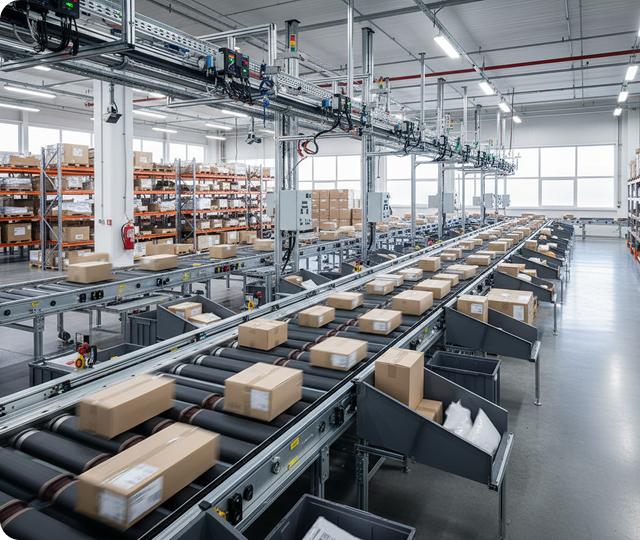
Perfect for space-constrained, straight-line layouts. Delivers ultra-high speed sortation along a modular linear path with dynamic discharge points on both sides.
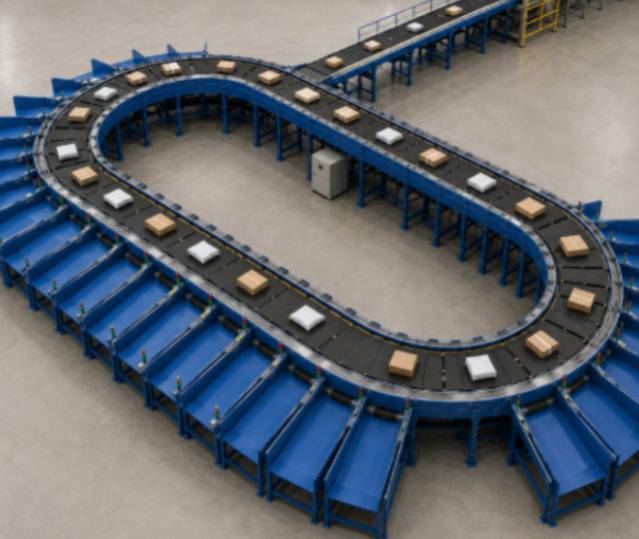
Continuous closed-loop configuration for maximum sortation density. Dynamically recirculates untargeted items for continuous flow and peak volume handling.
Each cart features an independent belt conveyor for gentle, precise diversion.
Automated singulation and gap control for seamless parcel feeding at full line speed.
Real-time destination assignment, diagnostics, and WMS/WCS integration for end-to-end orchestration.
Configurable discharge points with full/jam sensors and recirculation logic.
E-commerce boxes, polybags, packets and small mailers can be handled according to the system's specified parcel dimensions and weight range.
Envelopes, flyers, flat mailers and similar items can be sorted when they meet the system's minimum size and handling requirements.
Polybagged clothing, soft goods and other flexible packages can be handled using controlled belt-based transport and discharge.
Controlled belt-based discharge can provide a suitable handling approach for lightweight or delicate products when the parcel profile is compatible with the sorter.
Cross belt systems can support mixed SKU and parcel profiles, making them suitable for operations where dimensions, packaging and destinations vary.
Note: Parcel suitability depends on the carrier configuration and specified weight and dimensional limits. Very heavy or oversized items may require a different sortation or material-handling solution.
Throughput Designed Around Your Operation: Sorter capacity depends on factors such as carrier pitch, sorter speed, induction rate,
parcel profile, destination count, discharge requirements and re-circulation.
Quinta designs the system around your actual operating and peak-volume requirements rather than relying on a generic throughput figure.
Sort 10,000–20,000+ items/hour with 99.9% accuracy across SKU types.
Cross belt sorter conveyor design eliminates sliding friction — safe for polybags, padded mailers, and fragile goods.
Modular carts support narrow belt sorter configurations for small-parcel and packet sorting lines.
Plug into SAP, Manhattan, Blue Yonder, or custom warehouse management platforms.
A typical automated parcel flow can include:
Quinta designs automation systems around site-specific operating conditions, facility layouts, power requirements and operational requirements.
From concept development and system engineering to integration, installation, commissioning and ongoing support.
Quinta develops sortation solutions for e-commerce, courier, 3PL, retail and distribution operations based on throughput, parcel profile and facility requirements.
Cross belt sortation can be integrated with Quinta's wider automation ecosystem, including DWS, AIDC, robotics and sorting solutions.
Cross belt sorters typically fall under HS code 8428.39 (other continuous-action elevators and conveyors for goods) or 8428.90. We recommend confirming with your customs broker for your specific configuration.
Cross belt sorter pricing varies based on throughput, layout footprint, and chute count. Smaller modular setups typically start around $100,000 to $250,000, while high-capacity, enterprise-scale warehouse systems can range from $500,000 to over $2 million. Final costs depend on customization, integration with existing WCS/WES software, and required sorting speed.
Yes, you can download our comprehensive product brochure directly from this page. It offers a detailed breakdown of technical specifications, throughput capabilities, layout dimensions, chute configurations, and software integration options to help you evaluate if our cross belt sorter fits your warehouse automation strategy.
Cross belt sorters use bi-directional motor-driven belts on each carrier to actively discharge items, offering precise control for fragile, irregular, or high-speed parcel handling. Tilt-tray sorters mechanically tip trays to slide items using gravity, making them simpler and cost-effective, but less suited for delicate or non-standard goods.
Global leaders in cross belt sorter technology include industrial automation pioneers like Interroll, Vanderlande, Honeywell Intelligrated, Beumer Group, and Dematic. These manufacturers are renowned for high-throughput loop and linear sortation systems designed for large-scale e-commerce hubs, parcel distribution centers, and complex logistics facilities.
See the system in action at your facility. Our technical team will assess your warehouse layout and deliver a structured engineering brief tailored to your operation.
Our engineering team visits your facility and evaluates the operation first-hand.
We deliver a structured automation roadmap tailored to your operational profile.
You speak directly with our engineering team — no account managers in between.
See the system in action at your facility. Our technical team will assess your warehouse layout and deliver a structured engineering brief tailored to your operation.
Our engineering team visits your facility and evaluates the operation first-hand.
We deliver a structured automation roadmap tailored to your operational profile.
You speak directly with our engineering team — no account managers in between.
