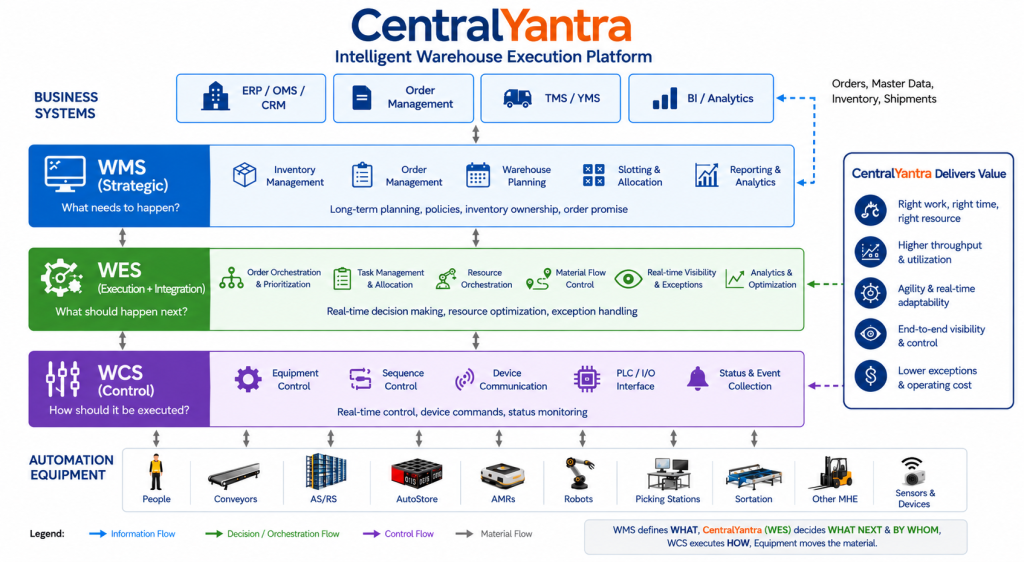
What Is a Warehouse Execution
System?

A Warehouse Execution System (WES) is software that coordinates and optimises warehouse operations in real time.

While a Warehouse Management System (WMS) manages inventory, orders, warehouse processes, and business-level instructions, a WES focuses on how those instructions are executed across people, equipment, and automation.

A WES can prioritise tasks, balance workloads, coordinate automation, respond to changing warehouse conditions, and connect multiple systems that otherwise operate independently.

Warehouse Execution System vs WMS vs WCS

The three systems serve different roles in a modern warehouse architecture.

System Primary role Focus
WMS Warehouse management Inventory, orders, locations, workflows, and business rules
WES Warehouse execution and orchestration Task prioritization, resource allocation, workflow coordination, and real-time optimization
WCS Warehouse control Real-time control of specific automation and material handling equipment

The Operational Core: 6 Intelligent Engines

CentralYantra brings warehouse state, task management, orchestration, system health, integration, and operational visibility into one execution architecture. Each engine addresses a different part of warehouse execution while working as part of a connected system.

Seamless Upstream and Downstream Connectivity

CentralYantra functions as a warehouse orchestration and integration layer between business systems and physical warehouse operations.

Warehouse Execution System coordinating WMS, WCS, robots, sorters and warehouse automation

This architecture allows information and execution decisions to move across the warehouse without requiring every automation system to independently communicate with every other system.

The result is a more connected approach to warehouse operations, where automation systems can be coordinated instead of operating as separate islands.

Warehouse State Engine

Real-time facility state tracking across all zones, equipment, and storage locations with event-level visibility.
• Live state telemetry

AI Task Management Engine

Custom rule-based task creation and prioritization beyond fixed workflows, with continuous refinement.
• Rule-aware scheduling

Orchestration Engine

Multi-agent coordination of people, robots, and software subsystems to keep work flowing across the facility.
• Conflict resolution

Health Engine

Monitors system health, exceptions, and diagnostics across warehouse automation equipment.
• Predictive fault detection

Integration Layer

Bridges WMS, ERP, PLCs, scanners, and automation systems with resilient data exchange.
• REST / MQTT / OPC-UA

Operations Control Tower

Centralised real-time visibility across the warehouse, with intervention and workflow controls in one place.
• Single pane of glass

Built for the Realities of Modern Fulfillment

Modern warehouses rarely rely on a single automation technology. A fulfillment center can have a WMS managing orders and inventory, a WCS controlling conveyors and sorters, robots moving goods, DWS systems capturing shipment information, and people handling exceptions.

The challenge is no longer simply automating individual processes. It is coordinating all of them. CentralYantra is designed to provide that execution and orchestration layer.

Modern warehouses rarely rely on a single automation technology. A fulfillment center can have a WMS managing orders and inventory, a WCS controlling conveyors and sorters, robots moving goods, DWS systems capturing shipment information, and people handling exceptions.

The challenge is no longer simply automating individual processes. It is coordinating all of them. CentralYantra is designed to provide that execution and orchestration layer.

Connect ERP, WMS, WCS, PLCs, robots, sorters, DWS systems, and other warehouse technologies through a common integration layer. This helps reduce the fragmentation created when automation systems are deployed independently.

A sorter can be highly efficient on its own. So can a robot, conveyor, DWS system, or automated storage system. The challenge comes when all of them need to work together. Warehouse orchestration software coordinates these connected systems around the broader warehouse workflow rather than treating each automation cell as a separate operation.

AI-based task management can help analyze operational conditions, identify patterns, prioritize work, and support faster execution decisions. The objective is not to remove operators from the process. It is to give warehouse teams better information and more responsive execution logic while keeping human intervention available for exceptions and decisions that require operational judgment.

Do You Need a WES If You Already Have a WMS?

A WMS does not automatically mean a warehouse needs a separate WES. The requirement depends on the complexity of the warehouse, the amount of automation involved, the number of systems that need to communicate, and how much real-time coordination is required.

A WES becomes particularly relevant when a warehouse needs to coordinate multiple automation systems, dynamically prioritize work, balance resources, or respond to changing conditions faster than a conventional warehouse management workflow can support.

When Warehouse Automation Systems Are Not Talking to Each Other

Adding automation does not automatically create an automated warehouse.

A warehouse can have a sorter, AMRs, conveyors, DWS, scanners, and other systems while still experiencing:

Bottlenecks between
automation zones
Idle equipment
Poor task prioritization
Delayed exception handling
Multiple disconnected software interfaces
Limited real-time visibility
Automation downtime that is difficult to diagnose
Manual intervention between otherwise automated processes

This is where an execution and orchestration layer becomes valuable.

Instead of adding another isolated system, a WES can provide a common layer for coordinating warehouse tasks, automation, and operational decisions.

Control Tower Software for Warehouse Operations

A warehouse control tower should do more than display dashboards. It should help operations teams understand what is happening, identify where execution is deviating from plan, and provide the information and controls needed to respond.

CentralYantra brings operational data from connected systems into a centralized execution view. Instead of monitoring individual systems independently, teams can work from a common operational picture.

Get Your Warehouse Intelligence Layer Started

Connect your warehouse systems, automation, and operators through an intelligent Warehouse Execution System and orchestration layer.

Please enable JavaScript in your browser to complete this form.

We’ll respond with a practical next step for your warehouse.

Frequently Asked Questions

A Warehouse Execution System (WES) is software that coordinates warehouse tasks, resources, people, and automation in real time. It typically works alongside systems such as WMS and WCS to optimize the execution of warehouse operations.

A WMS primarily manages warehouse information and business processes such as inventory, orders, locations, and workflow rules. A WES focuses on the real-time execution and coordination of those activities across available labor, equipment, and automation.

Not necessarily. The need for a WES depends on warehouse complexity, automation levels, integration requirements, and the amount of real-time coordination required. A WES becomes particularly relevant when multiple automation systems and operational resources need to work together dynamically.

A WES receives information and tasks from systems such as a WMS or ERP, combines that information with the current operational state of the warehouse, and coordinates execution across people, automation, and equipment. It can prioritize tasks, allocate resources, manage workflows, and respond to changing operating conditions.

The integration typically requires an interface between the WMS and the execution/control layer responsible for coordinating the automation. Depending on the architecture, this can involve APIs, messaging protocols, WCS interfaces, PLC communication, and other industrial or software interfaces.

Warehouse orchestration is the coordination of warehouse tasks, people, automation, and software systems so that individual processes work together toward the overall operational objective. Instead of optimizing each automation system independently, orchestration focuses on how the entire warehouse executes work.

The integration typically requires an interface between the WMS and the execution/control layer responsible for coordinating the automation. Depending on the architecture, this can involve APIs, messaging protocols, WCS interfaces, PLC communication, and other industrial or software interfaces.

A WES can provide centralized visibility into connected systems and help identify equipment states, exceptions, workflow interruptions, and downstream effects. The extent to which it can diagnose or respond to downtime depends on the specific automation architecture and integrations.

Physical AI orchestration refers to applying AI-driven decision-making to physical warehouse operations, where software coordinates machines, robots, people, and material flows based on real-world operating conditions. In a warehouse environment, this can include task prioritization, resource allocation, multi-robot coordination, and adaptive workflow decisions.

Main Menu

Call Now Button