
From AMR-based sorting to cross-belt systems — see which technology actually fits your throughput and parcel mix.
Table of Contents
Top Warehouse Sorting Technologies in 2026:
From Classic Mechanics to AMR-Based Sorting
Written by: Stephen Athokpam, Warehouse Automation Specialist, Quinta
Published Date: September 11, 2026
The logistics landscape is shifting faster than ever this year.
Skyrocketing order volumes are forcing facilities to analyze the latest warehouse sorting technologies in 2026.
Choosing the right warehouse automation keeps your facility accurate and highly profitable.
Today, we look at the top types of sorting systems in logistics dominating modern supply chains.
What Is AMR-Based Sorting and Why Are High-Volume Warehouses Switching in 2026?
Autonomous Mobile Robots (AMRs) are completely redefining how we think about product sortation.
Instead of moving packages along fixed lines, a modern AMR sortation system carries items independently.
How AMR Sortation Systems Work: Raised Platforms, Destination Chutes, Scalable Fleets?
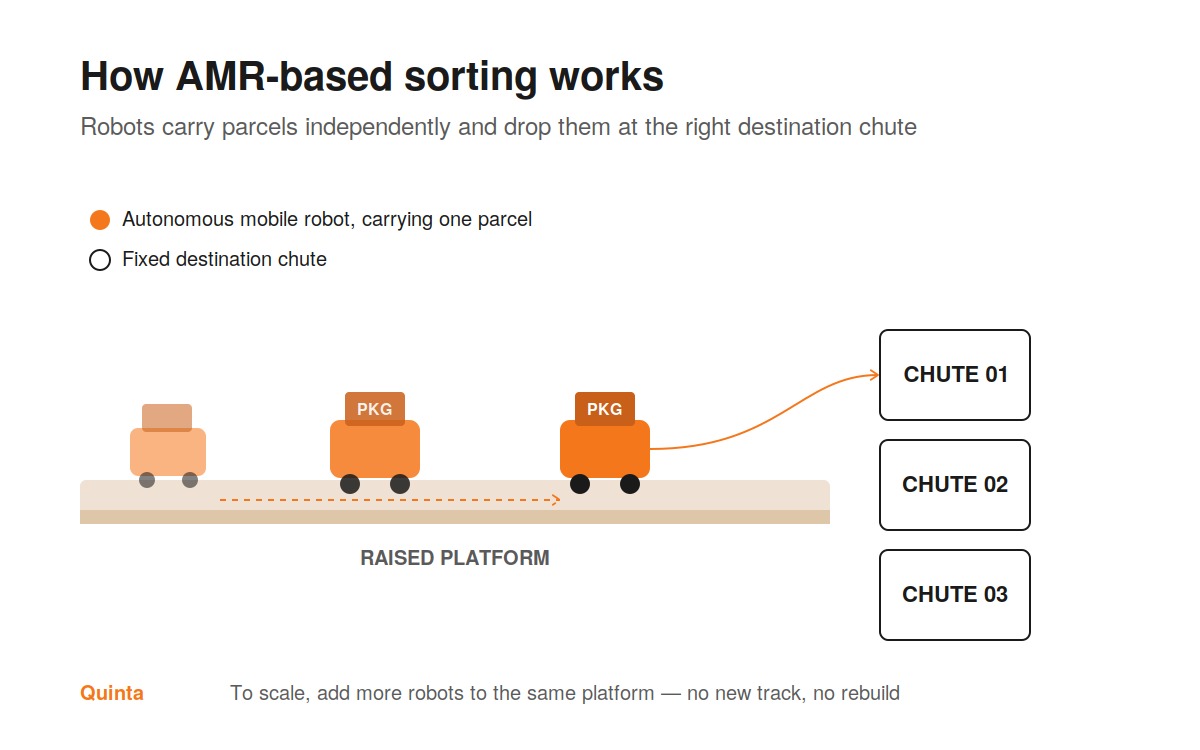
The robots travel across a raised platform and drop parcels into designated destination chutes.
This layout provides unmatched flexibility because you can scale your fleet up or down instantly.
Talk to our automation consultants — no obligation.
How to Scale Warehouse Throughput 300% Without Rebuilding Your Floor? (The Quinta Integration Advantage)
Imagine an e-commerce warehouse facing a massive 300% order spike during a holiday weekend.
Instead of rebuilding physical layout lines, you simply add more AMRs to the platform.
This kind of scalability lines up with where national policy is headed too: the National Logistics Policy aims to bring India’s logistics cost down to a global-benchmark 8% of GDP by 2030, and warehouse-level throughput gains are a direct contributor to that target.
At Quinta, we design the software intelligence layers that make this rapid scaling effortless.
Our team specializes in building the best Intralogistics Automation Systems for modern e-commerce.
See how Quinta deploys AMR-based sorting in weeks, not months.
Cross-Belt Sorter: The Fastest Automated Sorting System for High-Volume Logistics
How a Cross-Belt Sorter Works: Motorized Carts, Perpendicular Discharge, Zero Downtime?
When absolute speed and high volume are your primary goals, a cross-belt sorter remains the industry standard.
This automated sorting system consists of a continuous train of small, independently motorized conveyor carts.
As a cart reaches its destination, the tiny belt runs perpendicular to the main track.
It quickly drives the package off the line and down the correct chute with extreme precision.
Depending on SKU profile and configuration, automated sortation systems like these typically achieve throughput rates of 1,500 to 4,000 picks per hour, per industry benchmarking from Mark Wide Research which is well beyond what manual sortation lines can sustain.
How to Achieve Near-Zero Sort Errors at Peak Velocity in a Courier Hub?
Think of an international courier hub processing tens of thousands of mixed overnight envelopes.
The system must scan, weigh, and sort these diverse items without a single second of belt downtime.
Quinta’s cross-belt solutions are engineered specifically to eliminate tracking drift on these high-speed lines.
We focus on the mechanical precision of the discharge, keeping your error rates near zero even at peak velocity.
Swing-Arm vs Swivel Wheel Sorter: Which Is Right for Your Warehouse in 2026?
Not every warehouse requires multi-million dollar robot fleets or massive cross-belt tunnels.
For low-to-medium volume lines, traditional directional sorters offer excellent efficiency at a lower price point.
Swing-Arm Sorter: Best Sorting System for Heavy Industrial Parts and Plastic Totes
A swing-arm sorter uses a mechanical gate that swings out to push heavy items.
It acts like a gatekeeper, deflecting durable boxes or plastic totes into alternative shipping lanes.
Swivel Wheel Sorter: Best Sorting System for Fragile Items, Polybags, and E-Commerce
Conversely, a Swivel Wheel Sorter uses small, steerable wheels embedded directly inside the conveyor bed.
These wheels pivot dynamically to gently steer fragile items or thin polybags without impacting them.
How to Run Heavy and Fragile Sorting Lines in One Facility (Quinta's Modular Approach)
Picture a distribution center that ships heavy, rigid automotive parts alongside fragile cosmetics.
The facility uses tough swing arms for the heavy iron parts that can handle a hard mechanical push.
For the delicate cosmetics, they route the boxes over smooth swivel wheels to prevent internal damage.
Quinta specializes in blending these diverse modules into a single, cohesive warehouse sorting system.
2026 Warehouse Sorting Technology Comparison: Speed, Flexibility, and Cost at a Glance
Every technology addresses specific operational variables on your warehouse floor.
Here is how the leading options compare across key metrics.
| Sorting Technology | Throughput Level | Flexibility Rating | Primary Ideal Product Profile |
|---|---|---|---|
| AMR-Based Sorting | Moderate (Scalable) | Extremely High | Small parcels, polybags, and footwear |
| Cross Belt Sorter | Ultra-High | Low (Fixed Steel) | High-volume mixed mail, small boxes |
| Swivel Wheel Sorter | Medium-High | Medium | Fragile items, varied cardboard cartons |
| Swing Arm Sorter | Medium | Low | Heavy industrial parts, plastic warehouse totes |
Note: “Load-Type Flexibility” refers to how well a system adapts to varied parcel shapes, weights, and materials — not floor-layout flexibility. Quinta’s linear cross-belt systems remain the top choice for footprint flexibility in brownfield warehouses; see our Linear Cross-Belt Sorter guide for that comparison
We’ll assess your operation and recommend the right fit.
Elevating Your Throughput Engine
The right choice depends entirely on your specific parcel mix, volume targets, and growth strategy.
Automation is no longer about buying generic hardware; it is about building a scalable workflow.
At Quinta, we don’t just sell machinery instead we architect complete data to-motion logistics solutions.
Contact our engineering team today to audit your current layout and find your perfect technology match.
Frequently Asked Questions About Warehouse Sorting Technologies
AMR systems require a lower initial infrastructure investment because they do not use permanent steel framing.
However, you must budget for software licensing and battery management systems over the lifecycle.
Cross belt sorters have high upfront engineering costs but offer a lower cost-per-parcel at maximum volumes.
Fixed-line systems like swivel wheels adjust dynamically using precise vision sensors to guide flexible bags safely.
Swing arms struggle here, as light polybags often slide underneath the gate and cause system jams.
AMRs excel with polybags because the parcel sits completely flat on top of the robot during transport.
A swing arm relies on physical impact force to forcefully change a package's path across the conveyor belt.
A wheel sorter changes the tracking angle of the wheels beneath the parcel to guide it smoothly.
This fundamental difference makes the wheel sorter vastly superior for fragile items or delicate packages.
A modern Sorting System for E-commerce layout often requires a blend of technologies to optimize throughput.
If your parcel profile includes both heavy totes and soft polybags, a hybrid conveyor line is ideal.
Quinta specializes in integrating diverse modules into a seamless layout to handle mixed cargo efficiently.
Traditional conveyor sortation systems take months of layout design, mechanical installation, and on-site wiring.
AMR installations can be completed in weeks since they rely on software mapping rather than bolted steel. Quinta’s rapid-deployment protocols ensure your transition to automation minimizes operational disruption.
AMR-based sorting uses Autonomous Mobile Robots that carry parcels independently across a raised platform, dropping them into designated destination chutes instead of moving packages along a fixed conveyor line.
Because AMRs don't rely on permanent steel framing, a facility can scale up simply by adding more robots to the existing platform, rather than redesigning physical layout lines to absorb peak-season volume.
A cross-belt sorter uses a continuous train of small, independently motorized conveyor carts. When a cart reaches its destination, its belt runs perpendicular to the main track, driving the parcel off the line and into the correct chute.
According to the 2026 comparison, the cross-belt sorter offers ultra-high throughput, ahead of swivel wheel (medium-high), swing arm (medium), and AMR-based sorting (moderate but scalable).
Its engineering is built to eliminate tracking drift on high-speed lines, keeping mechanical discharge precise and error rates near zero even when scanning, weighing, and sorting tens of thousands of mixed items without downtime.
About Author

Stephen Athokpam is a Warehouse Automation Specialist at Quinta, covering high-speed sortation systems, material handling tech, and distribution center optimization.
Stephen Athokpam is a Warehouse Automation Specialist at Quinta, covering high-speed sortation systems, material handling tech, and distribution center optimization.

