
Table of Contents
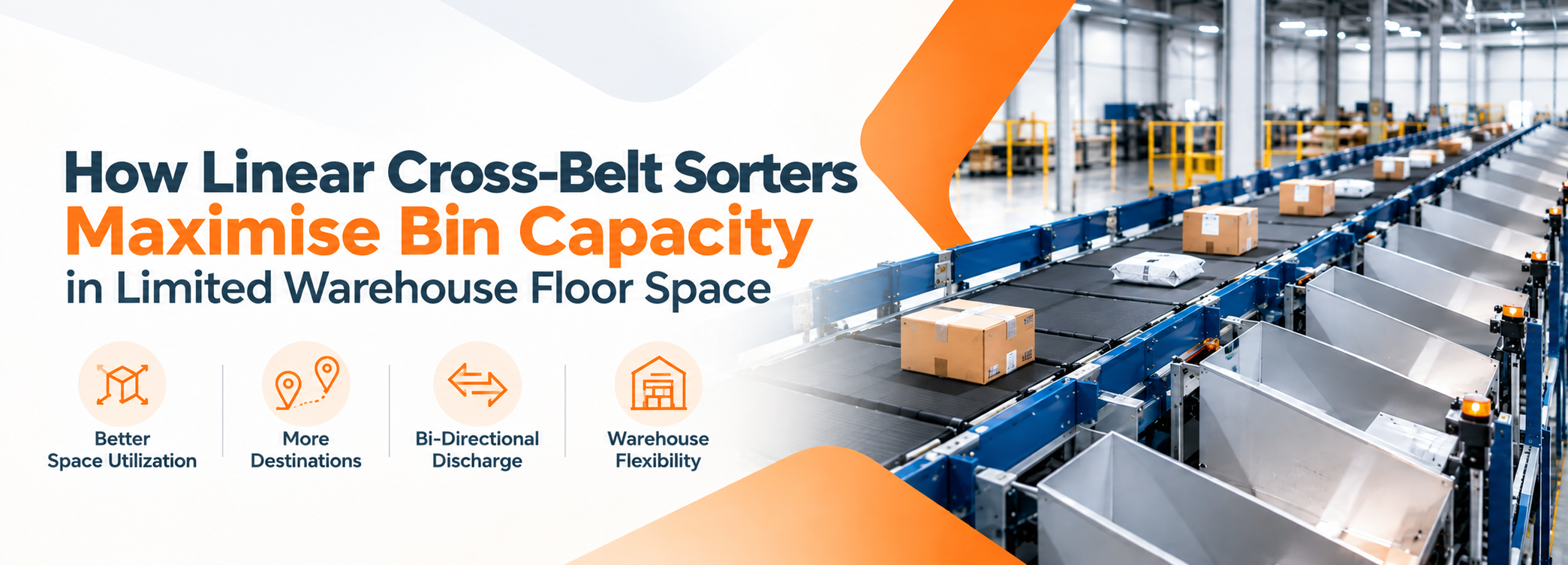
How Linear Cross-Belt Sorters Maximise Bin Capacity in Limited Warehouse Floor Space?

Warehouse Automation Specialist, Quinta
Published Date: September 29, 2026
A linear cross-belt sorter can maximise destination capacity within a limited warehouse footprint by using bi-directional discharge.
Depending on the layout, parcels can be sorted to chutes on both sides of the track. This can help warehouses use available floor space more efficiently without expanding the sorter corridor.
The actual destination capacity depends on factors such as track length, carrier spacing, chute dimensions, parcel size, throughput and warehouse layout.
What We Cover in This Article?
| Section | What You Will Learn |
|---|---|
| Floor-Space Challenge | Understand how warehouse floor space affects sorter and destination planning. |
| Bi-Directional Cross-Belt Actuator | Learn how parcels can discharge to either side of the track. |
| Bin Capacity & Destination Density | Understand what affects destination capacity within a fixed sorter footprint. |
| Cross-Belt vs. Swing Arm Sorter | Compare the two systems based on floor space and destination placement. |
| Brownfield Warehouse Planning | Learn how columns, conveyors and other structures affect sorter layout. |
| Warehouse Floor Evaluation | Learn what to check before selecting a linear cross-belt sorter. |
| DWS & WCS Integration | Understand how DWS, WCS and cross-belt sortation work together. |
| Quinta's Linear Cross-Belt Sorter | See how the solution can be evaluated for space-constrained warehouses. |
The Floor-Space Challenge in Sorter Selection
By the time a warehouse team shortlists sorter vendors, most needs are clear.
The team knows the required throughput.
The parcel mix is known.
The budget is planned.
But one question may still remain:
How many sort destinations can the available floor space support?
This matters even more in a brownfield warehouse.
Existing warehouses may have:
- Walls
- Columns
- Conveyors
- Storage systems
- Aisles
- Loading areas
These can limit the space available for new automation.
So the question is not only:
“Do we have enough space for a sorter?”
It is also:
“How many destinations can fit into the space we have?”
This is where sorter design matters.
A Linear Cross Belt Sorter uses a bi-directional discharge system. It can move parcels to the left or right side of the track, based on the system layout.
This can give warehouse teams more options when placing destination chutes.
A Linear cross-belt sorter system can help optimise warehouse floor space by allowing destination chutes on both sides of the track, where the layout allows it.
Actual capacity depends on:
- Track length
- Carrier spacing
- Chute size
- Parcel size
- Throughput
- Warehouse layout
Why Does Sorter Architecture Affect Bin Capacity?
Bin capacity is not only about the number of bins.
It also depends on how the sorter sends parcels to each destination.
The basic flow is:
Sorter → Discharge → Chute → Destination
A sorter that discharges to one side has fewer options for chute placement.
A bi-directional cross-belt sorter can discharge parcels to either side.
This can allow chutes on both sides of the track.
The final layout depends on the warehouse and system design.
Key factors include:
- Sorter track length
- Carrier spacing
- Chute width
- Parcel size
- Parcel weight
- Throughput
- Number of destinations
- Warehouse layout
- Safety space
- Maintenance space
Warehouse layout is also important for warehouse floor space optimisation.
How Does a Bi-Directional Cross-Belt Actuator Work?
A linear cross-belt sorter has carriers with an integrated belt.
The carrier moves the parcel along the track.
When it reaches the right point, the belt moves the parcel toward the chute.
The parcel can move:
- Left
- Right
The Warehouse Control System (WCS) controls the routing.
It uses data such as the barcode and destination code.
The basic process is:
Parcel Induction
↓
DWS – Dimensioning, Weighing & Scanning
↓
Barcode / Destination Identification
↓
WCS Assigns Destination
↓
Linear Cross-Belt Carrier
↓
Left or Right Discharge
↓
Destination Chute
↓
Collection / Dispatch
The belt is part of the carrier.
So the same carrier can serve destinations on either side of the track.
This is a key feature of a bi-directional cross-belt sorter.
Does Bi-Directional Discharge Double Bin Capacity?
Not necessarily.
Bi-directional discharge can increase the number of possible destination positions.
This is because chutes can be placed on both sides of the track when space allows.
But it does not mean that bin capacity will always double.
Actual cross-belt sorter bin capacity depends on:
- Track length
- Carrier pitch
- Chute width
- Parcel dimensions
- Parcel weight
- Throughput
- Number of destinations
- Available floor space
- Maintenance access
- Safety needs
For example, a warehouse may have clear space on both sides of the sorter.
It may then be possible to use both sides for destination chutes.
Another warehouse may have columns or conveyors in the way.
It may have fewer options.
So the key benefit is not simply “double the bins.”
A better way to explain it is:
Bi-directional discharge can increase destination capacity within a fixed sorter corridor by allowing destinations on both sides of the track.
What Determines Cross-Belt Sorter Destination Density?
Cross-belt sorter destination density means the number of destinations that can fit within a sorter area.
Several factors affect it.
1. Sorter Track Length
A longer track gives more space for destination chutes.
2. Carrier Pitch
Carrier spacing affects how close discharge points can be.
3. Chute Configuration
Chute width and depth affect the number of destinations that can fit.
4. Parcel Characteristics
Parcel size, weight and packaging can affect the chute design.
5. Warehouse Layout
Columns, walls and conveyors can limit available space.
6. Throughput
The sorter must handle the required parcel flow.
7. Safety and Maintenance
The layout must leave enough space for safe work and maintenance.
So cross-belt sorter destination density should be planned as part of the full warehouse layout.
It should not be based only on the number of chutes.
Linear Cross-Belt Sorter vs Swing Arm Sorter: Floor-Space Comparison
Different sorter types use different discharge methods.
This affects chute placement.
| Attribute | Linear Cross-Belt Sorter | Swing Arm Sorter |
|---|---|---|
| Discharge Direction | Can discharge parcels to the left or right. | Usually discharges parcels in one direction. |
| Destination Placement | Can use both sides of the track where the layout allows. | More limited by the discharge direction. |
| Discharge Method | Integrated cross-belt mechanism. | Mechanical arm or paddle. |
| Floor-Space Use | Can make use of both sides of the sorter track. | One side may not be available for sort destinations. |
| Layout Flexibility | Can suit different warehouse layouts and destination requirements. | Depends more on arm and chute arrangement. |
| Key Selection Factors | Track length, carrier pitch, parcel type, throughput and warehouse layout. | Throughput, parcel type, discharge layout and available space. |
Why Chute Utilisation Matters as Much as Chute Count?
More chutes do not always mean more usable capacity.
You also need to look at how each chute is used.
A chute needs enough space for parcels to collect.
The flow is:
Parcel → Sorter → Chute → Collection → Dispatch
High-volume destinations may need more chute space.
When planning chute capacity, consider:
- Parcel size
- Parcel arrival rate
- Destination volume
- Chute size
- Collection method
- Operator access
- Dispatch needs
So, look at usable chute capacity, not only chute count.
This is also important for warehouse floor space optimisation.
Is a Linear Cross-Belt Sorter Suitable for Brownfield Warehouses?
A brownfield warehouse already has buildings, equipment and fixed structures.
These may include:
- Columns
- Conveyors
- Storage systems
- Walls
- Aisles
- Loading areas
- Other automation
These items can limit the space for a sorter.
A linear cross-belt sorter for a space-constrained warehouse can be considered when there is a suitable straight corridor.
The design should consider:
- Track length
- Required destinations
- Parcel profile
- Throughput
- Chute layout
- Column locations
- Maintenance access
- Existing material flow
The sorter should fit the warehouse layout.
The final design should be checked against the actual site.
How to Evaluate Warehouse Floor Before Selecting a Sorter?
Before choosing a sorter, review your available floor space.
1. Measure the Track Area
Find the clear space available for the sorter.
Mark columns, walls and other obstacles.
2. List the Required Destinations
List all destinations the sorter must serve.
Also check the volume for each destination.
3. Review Parcel Characteristics
Check:
- Parcel size
- Parcel weight
- Packaging type
These details can affect sorter and chute design.
4. Define Peak Throughput
Use peak parcel flow when planning the system.
Average daily volume may not show the real requirement.
5. Review Chute Requirements
Check:
- Chute width
- Chute depth
- Collection method
- Destination volume
6. Map Existing Equipment
Mark:
- Conveyors
- Storage systems
- Columns
- Walls
- Other equipment
7. Allow Maintenance Space
Make sure operators and maintenance teams have enough access.
A good sorter assessment should consider:
Floor Space + Destination Capacity + Parcel Profile + Throughput
This helps evaluate linear sorter space efficiency.
Can a Linear Cross-Belt Sorter Integrate With DWS and WCS?
Yes.
A linear cross-belt sorter can be part of an automated warehouse sorting system.
It can work with DWS and Warehouse Control Systems (WCS).
A typical process is:
Parcel Induction
↓
DWS System
↓
Barcode / Destination Identification
↓
WCS Routing Decision
↓
Linear Cross-Belt Sorter
↓
Left or Right Discharge
↓
Destination Chute
↓
Collection / Dispatch
The DWS system captures parcel data.
The WCS uses this data for routing.
The cross-belt sorter then moves the parcel to the assigned destination.
This makes the sorter part of a wider Warehouse Automation System.
How Does a Linear Cross-Belt Sorter Help Optimise Warehouse Floor Space?
A linear cross-belt sorter can help optimise floor space by allowing parcels to discharge to either side of the track.
This can allow destination chutes on both sides.
It can also give planners more flexibility when working with a fixed sorter footprint.
However, actual destination capacity depends on:
- Track length
- Carrier spacing
- Chute size
- Parcel characteristics
- Throughput
- Warehouse layout
This makes the cross-belt sorter footprint an important part of sorter planning.
Why Consider Quinta's Linear Cross-Belt Sorter?
Quinta’s warehouse sortation system uses bi-directional cross-belt cells.
These cells can discharge parcels toward either side of the track.
The direction depends on the assigned destination and system configuration.
This can be useful when floor-space utilisation and destination capacity are key parts of sorter planning.
For brownfield and existing warehouses, the system can be reviewed based on:
- Available floor space
- Track length
- Parcel mix
- Required throughput
- Destination needs
- Chute configuration
- Existing infrastructure
The goal is to create a sorter layout that fits the warehouse.
Quinta also offers linear sorter systems for different warehouse and logistics applications.
If your warehouse has limited space, a site-specific assessment can help identify a suitable sortation layout.
Frequently Asked Questions
A linear cross-belt sorter can use both sides of the track for destinations, increasing destination positions within a fixed area. Actual capacity depends on track length, carrier spacing, chute size and layout.
Not always. Bi-directional discharge can allow chutes on both sides of the track. But actual cross-belt sorter bin capacity depends on the full system design
There is no fixed destination count. It depends on track length, carrier spacing, chute size, parcel type, throughput, and available floor space. The final count should be calculated for the specific warehouse.
Yes, a linear cross-belt sorter can suit a brownfield warehouse if the layout allows it. The design must consider columns, walls, conveyors, storage areas, and access space. The final layout should be checked against the actual site.
The WCS uses parcel and destination data to decide where each parcel should go. When the carrier reaches the assigned destination, the cross-belt moves the parcel toward the correct chute.
Yes. A linear cross-belt sorter can integrate with DWS and WCS to identify, route, and sort parcels to the correct destination chute. The exact setup depends on the warehouse system.
The main difference is the discharge method. A linear cross-belt sorter uses an integrated belt to discharge parcels to either side, while a swing arm sorter uses a mechanical arm or paddle. The right option depends on layout, parcel type, throughput, and destination needs.
Compare verified throughput, parcel range, sort accuracy, integration capability, maintenance support, spare-parts availability, service coverage, expansion options and project references.
Possible causes include barcode/scanner issues, induction timing, parcel characteristics outside the designed envelope, controls configuration and mechanical issues.
It can handle appropriately packaged fragile products, but unboxed fragile items should not be assumed to be suitable.
References
Honeywell – Grow Smarter: Warehouse Execution System (WES)
Explains the different roles of WMS, WES and WCS, including WMS for warehouse transactions, WES for real-time orchestration, and WCS for interfacing with material-handling equipment. Honeywell – Grow SmarterSAP Help Portal – Connecting a Fully Automated Warehouse
Provides an example of how WMS and external warehouse-control systems can be structured in highly automated warehouses. SAP Help Portal – Fully Automated Warehouse
About Author
Stephen Athokpam is a Warehouse Automation Specialist at Quinta, covering high-speed sortation systems, material handling tech, and distribution center optimization.
Stephen Athokpam is a Warehouse Automation Specialist at Quinta, covering high-speed sortation systems, material handling tech, and distribution center optimization.

