
Why 90% of Parcel Damage Occurs at the Sorter-to-Chute Handshake?
Published Date: October 22, 2026
The sorter-to-chute handshake, the moment a parcel leaves the sorting belt and drops into the chute is where most parcel damage happens, not during transport through the rest of the warehouse.
Linear cross-belt sorting system fix this by controlling the timing and angle of that drop instead of leaving it to chance or manual handling.
Key Takeaways
- Understand the sorter-to-chute handshake: Parcel damage can occur when packages leave the sorting belt and enter collection chutes.
- Prevent parcel-on-parcel collisions: Poor landing angles and closely spaced parcels can increase the risk of impact inside chutes.
- Recognize manual sorting limitations: Inconsistent timing and parcel placement can make damage risks harder to control during busy periods.
- Control parcel discharge: Linear cross-belt sorters use controlled belt movements to manage how parcels exit carriers and enter designated chutes.
- Improve parcel spacing: Precisely timed discharge can help reduce overlapping arrivals and collisions at collection points.
- Understand the cost of damage: Damaged parcels can lead to returns, replacements, claims, additional labour, and customer dissatisfaction.
Where Does Most Parcel Damage Actually Happen in a Warehouse?
Most warehouses blame parcel damage on rough handling, bad packaging, or careless workers.
But there is one exact moment where most of it actually happens.
It is the instant a parcel leaves the sorting line and lands in the chute.
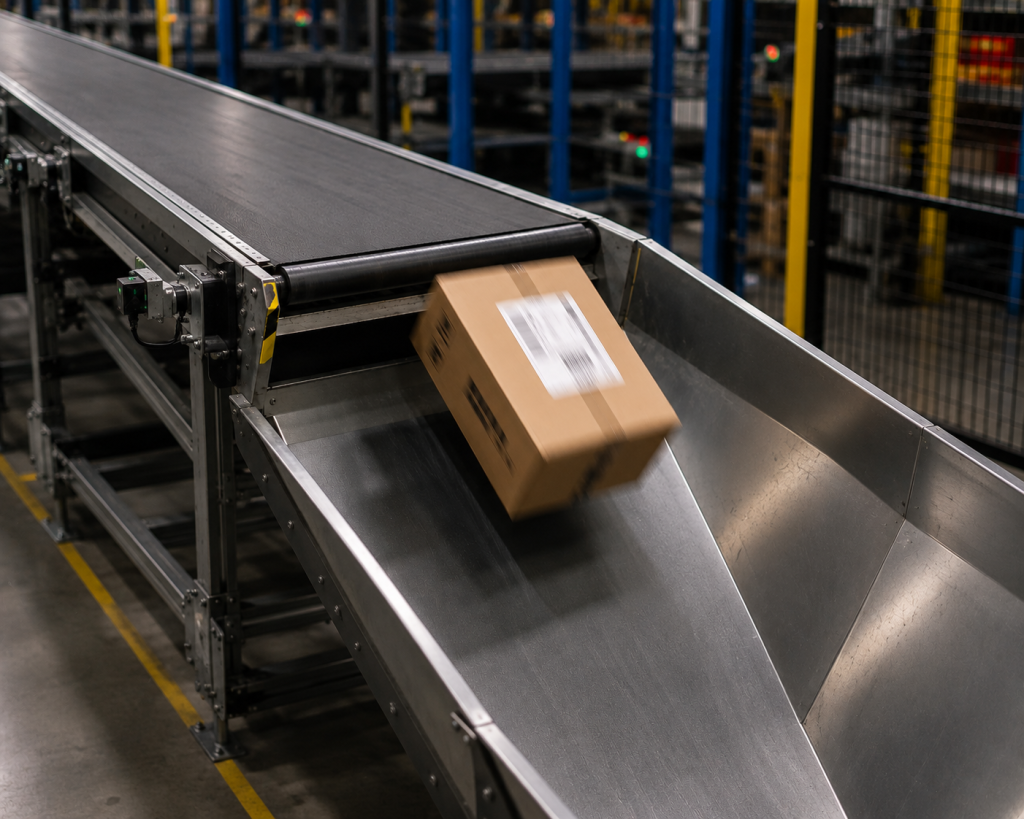
We call this the sorter-to-chute handshake.
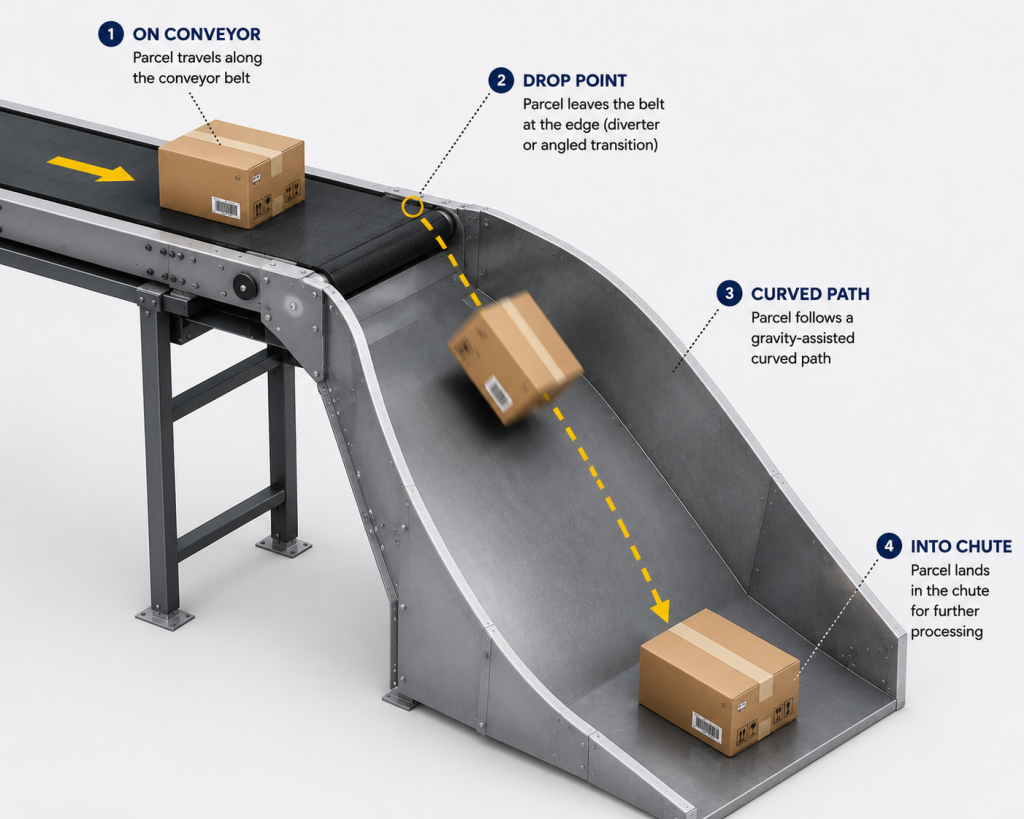
It is a handoff. The parcel goes from moving on a belt to dropping, sliding, or tumbling into a collection point.
A huge share of parcel damage happens in this one short moment, not during the rest of the journey through the warehouse.
This blog breaks down why that handoff is so risky, why it gets worse with manual handling, and how linear cross-belt sorters are built to fix exactly this problem.
What Happens During the Sorter-to-Chute Handshake?
Think about what a parcel goes through in this one moment.
It is moving at speed. Then suddenly, it changes direction and drops into a chute.
If the timing or angle is even slightly off, the parcel does not land flat. It tips, spins, or hits the chute wall first.
Understanding Parcel-on-Parcel Collisions at the Chute
This is where parcel-on-parcel collision comes in.
If parcels are arriving close together, and one of them lands at a slightly wrong angle or speed, it does not just sit in the chute quietly. It bumps into the parcel that landed just before it.
Now you have two boxes colliding, not one box hitting a wall.
This kind of collision is harder to prevent than people think. A packaging industry study on small-parcel shipping found that most damage occurs at corners and edges, not on flat surfaces, because boxes naturally tip and roll rather than landing perfectly straight.¹
That detail matters. A flat landing is gentle. A tipped, rolling landing turns a soft drop into a sharp impact, especially if it knocks into another parcel already in the chute.
Why Does Manual Handling Increase Parcel Damage Risk?
In a manual sorting setup, workers are placing parcels into chutes by hand or with simple push mechanisms.
There is no fixed timing. No fixed angle. No way to make sure two parcels never land in the chute at almost the same moment.
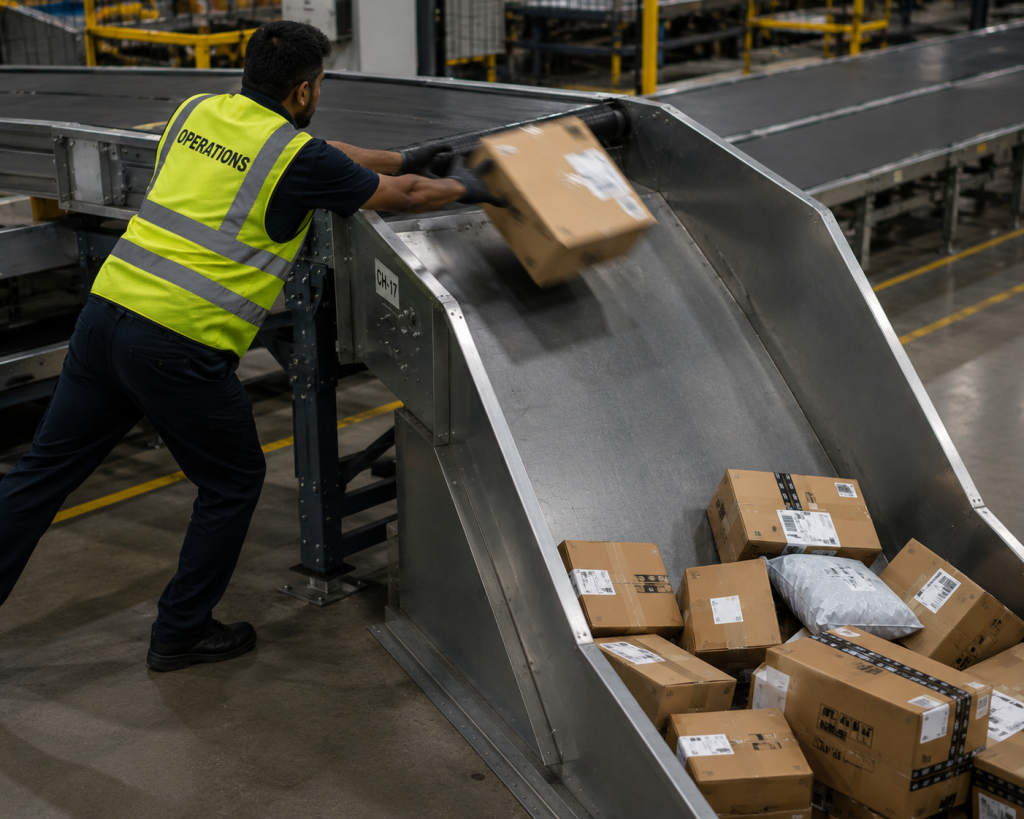
A tired worker at hour seven of a shift is not thinking about the exact angle a box should land at. They are thinking about speed.
This is exactly the kind of inconsistency that packaging engineers have flagged for decades.
Standard small parcel guidelines note that automated and manual sorting systems cannot reliably control the orientation in which a package lands, so packages often land in whatever position is least stable, not the safest one.²
In a busy chute, this turns into a pile of parcels landing at random angles, on top of each other, at random times.
Every random landing is a small chance of collision. Multiply that by thousands of parcels a day, and the damage adds up fast even if no single worker is doing anything wrong.
How Much Does Parcel Damage Actually Cost a Warehouse?
Damage at the chute does not just mean a broken box.
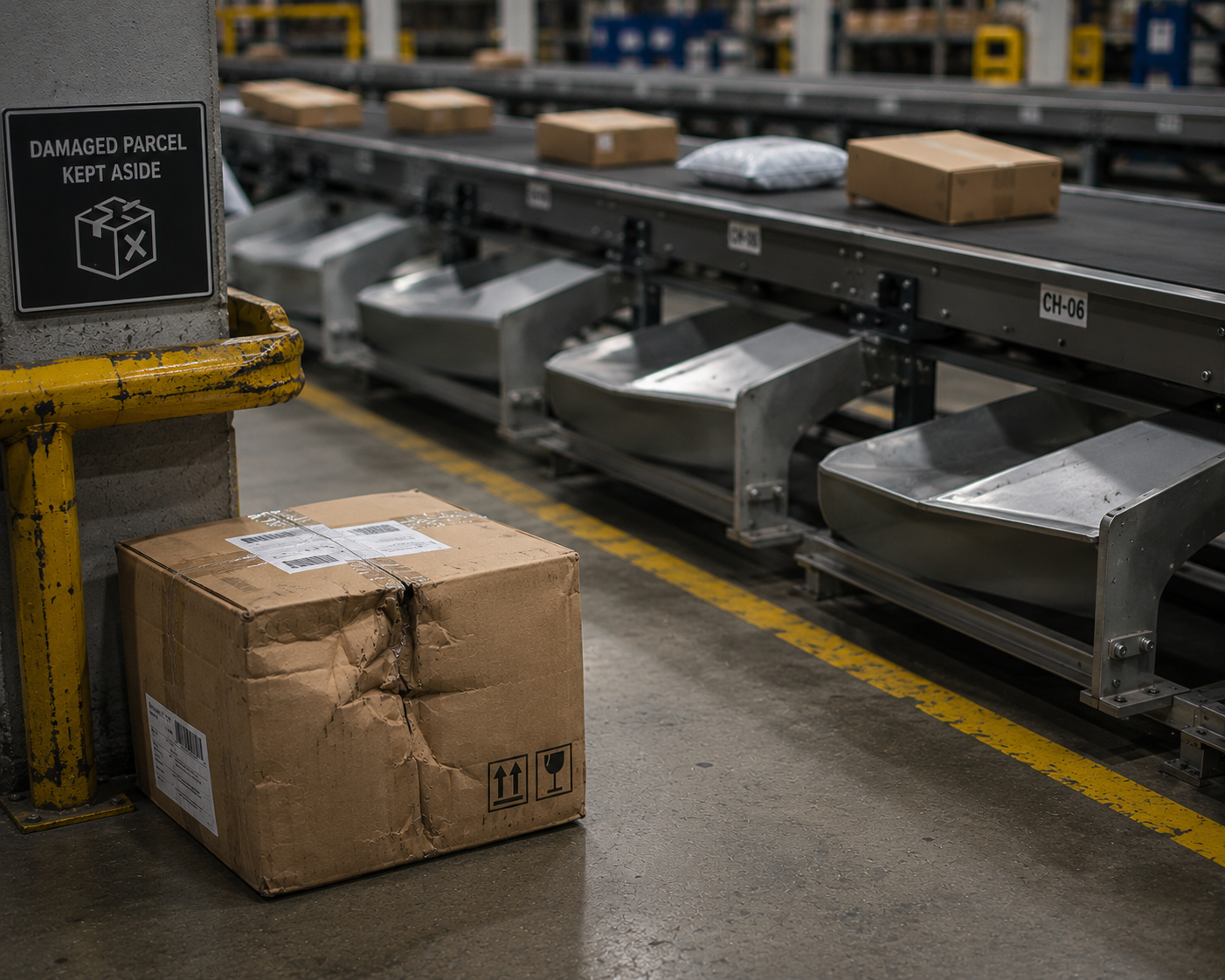
It means returns, replacement shipments, and unhappy customers, before the product even reaches them.
For a warehouse running thousands of parcels a day, even a small damage rate adds up to real money every single month.
It also adds hidden labour. Someone has to notice the damage, document it, repack or replace the item, and process the claim. None of that work moves a single parcel closer to its customer.
This is the part most damage-prevention conversations miss. The fix is not just better packaging.
It is reducing the number of risky moments a parcel goes through and the handshake is one of the riskiest moments in the entire journey.
How Linear Cross-Belt Sorting System Prevent Chute Damage?
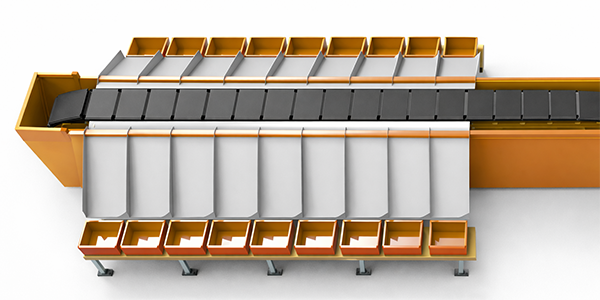
This is the part that actually solves the problem, not just describes it.
A linear cross-belt sortation system does not push a parcel off the line and hope it lands well.
Each parcel sits on its own small belt, called a carrier.
When it is time to discharge, that small belt turns on at a specific, controlled speed. This is not a guess.
It is a timed, calculated motion built into the system’s control logic, designed so the parcel turns and exits in a controlled way rather than just sliding off the edge.³
Because the timing is controlled by a Conveyor-based automated sortation system and not by a person’s reflexes, two things change.
Controlled, Predictable Landings
The parcel tends to land flatter and more predictably, because the discharge motion is built to manage the parcel’s rotation, not just shove it sideways.
Precision-Timed Discharge Spacing
Second, the system can space out discharges with precision.
It does not send two parcels into the same chute at almost the same second, because it knows exactly when each carrier will arrive and discharge.
Fewer random landings. Fewer angles. Fewer collisions.
This is also why an automated high speed linear cross-belt sorters are increasingly the preferred cross belt sortation systems for high-volume warehouse automation where even a small damage rate becomes a high cost at scale.
Manual Handling vs. Linear Cross-Belt Sorters: A Side-by-Side Comparison
| What Happens at the Chute | Manual Handling | Linear Cross-Belt Sorters |
|---|---|---|
| Discharge timing | Depends on the worker, changes shift to shift | Fixed and controlled by the system every time |
| Landing angle | Random, depends on how the parcel was placed or pushed | Managed by a controlled belt-turn motion |
| Spacing between parcels | Hard to control by hand at speed | Calculated so parcels do not arrive together |
| Collision risk | Higher, especially during rushed or busy periods | Lower, because timing removes most of the guesswork |
| Consistency across a shift | Drops as workers tire | Stays the same all day |

