
Table of Contents
Processing 4,000+ shipments/hour?
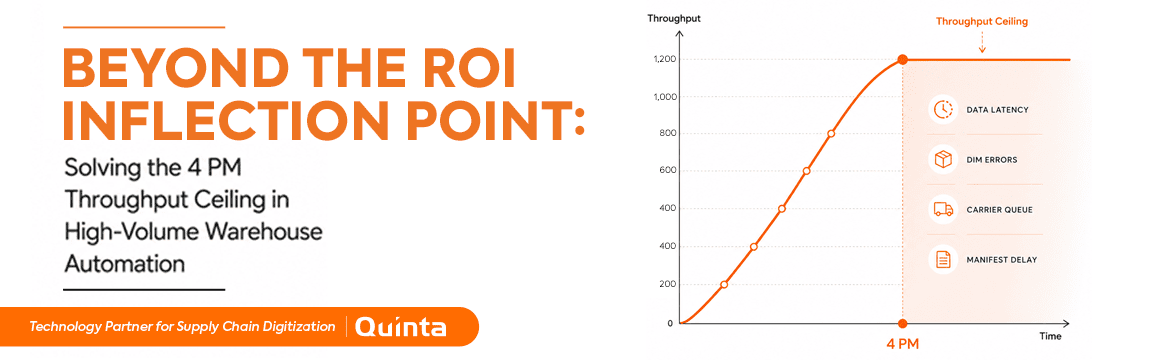
Beyond the ROI Inflection Point: Solving the 4 PM Throughput Ceiling in High-Volume Warehouse Automation
The 4 PM Wall: What Warehouse Automation Is Really Solving For
Does your facility hit the 4 PM wall?
Let’s map your throughput bottleneck — free 30-min call.
It is 3:47 PM at a Tier-1 e-commerce fulfilment hub somewhere in India.
By now, the morning is already gone in a blink, and the same warehouse that was shipping 2000 shipments in under an hour has completely transformed into something else.
The volume is climbing fast and has now surpassed 5,000 shipments per hour, with the numbers still rising.
By 4 PM, the number of parcels will peak at 6,500.
There are four national carriers, 73 minutes away, who are going to pull into the dock simultaneously.
The manifest must close by 5 PM. If it doesn’t, these shipments will miss the regional sorting centres by midnight.
The result?
Thousands of customers lose their next-day delivery SLA (Service Level Agreement).
The facility eats vehicle detention charges from four carriers at once.
And somewhere in the finance team’s inbox, a chargeback notification is already being drafted because a parcel that left this facility at 1.2 kg was billed to the carrier at 0.9 kg.
Allegedly, the operator who keyed in the weight had entered an incorrect decimal point due to fatigue.
This is a story about what happens when a high-volume sortation operation is built on a data infrastructure that cannot keep pace with its own throughput.
And loosely based on something we observed with one of our clients.
You see, it is not the workers who are the ceiling. The manual entry terminal is.
And this was the problem that we suggested to our client that Intralogistics Automation could solve.
The Friction Architecture: The 4 PM Crash Was Structural, Not Situational
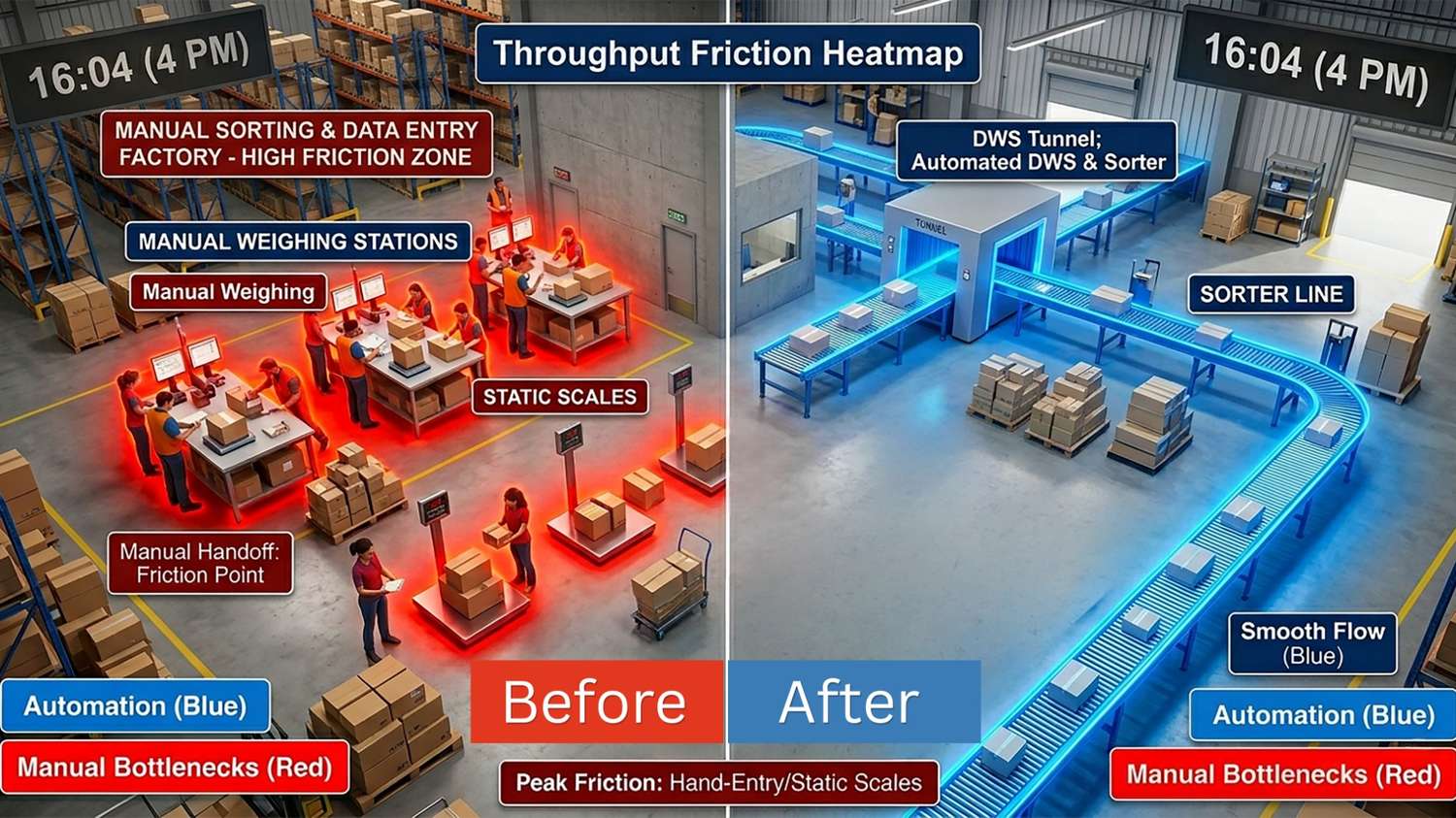
Let’s reconstruct what the “Before” state actually looks like inside the facility.
The setup is a standalone static DWS, a weighing scale, a tape measure for dimensions, and a data entry terminal.
The procedure looks like this:

On paper, this takes about 8–10 seconds per parcel, if we are talking about ideal conditions.
In practice, by 3:30 PM, with the load on the brain adding up since morning, and the floor noise at its peak, that 8-second process stretches to a misread display, a re-entry, and a supervisor question.
Now, the thing to note is that a mistake from one individual hardly puts any dent in the whole process, but the total impact from multiple individuals for 6,500 parcels will be paramount.
The error rate in the morning, when everyone is energised and ready for the day, is about 1.5%.
Pretty low
Parcels are miscategorised, dimensions are under-declared, and weights are mis-keyed.
It is imperfect, but manageable.
Errors get caught.
Chargebacks trickle in.
But by 4 PM, that error rate will climb up.
The reason here is progressive overload mentally, not negligence.
As ambient noise rises, as the pace of incoming parcels accelerates, and as the pressure of the 5 PM manifest deadline sharpens, the human brain routes processing power away from precision and toward speed.
In India, this shortfall has a name: DIM under-declaration.
Carriers charge based on whichever is higher: actual weight or volumetric weight.
The calculations are as follows:
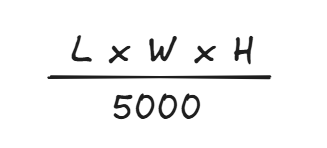
(L is Length, W is Width, H is Height, and 5000 is the DIM Factor*)
*The DIM factor is set by carriers to convert cubic centimetres into a kilogram equivalent for billing purposes.
When a parcel’s dimensions are under-declared or skipped during the rush, the warehouse bills the e-commerce client for actual weight.
The DIM Factor Is Not a Fixed Number — And That Is Part of the Problem
Your carriers are already calculating this number.
Your carriers are already calculating this number.
National carriers like Delhivery, Blue Dart, and Ecom Express largely standardise around 5000 for domestic surface freight. But regional and last-mile carriers operating in specific corridors, particularly across Tier-2 and Tier-3 routes out of hubs like Bhiwandi or Nelamangala, frequently operate on their own contractual DIM factors.
A regional carrier covering the Karnataka interior might bill at 4000.
A hyperlocal partner handling same-day delivery in dense urban zones might apply 6000 for certain parcel classes.
What this means practically is that a fulfilment hub dispatching through four carriers simultaneously may be applying four different DIM factors to four different carrier manifests.
In a manual operation, that complexity sits entirely on the operator entering the data.
Under full cognitive load, an operator is not cross-referencing a carrier rate card before typing a weight into a terminal.
They just want to move parcels as fast as they can.
The automated tunnel DWS eliminates this.
The DIM factor per carrier is configured in the WCS once.
Every parcel is calculated against the correct factor for its assigned carrier, automatically, at belt speed.
The variable that was previously a source of human error becomes a system parameter that never changes unless you change it.
The carrier invoices for the weight. The difference becomes a liability that the fulfilment hub absorbs.
At 6,500 shipments per hour, with the error rate increased past 1.5%, there will be compounding every hour, resulting in the loss of revenue.
This is the friction debt. And it gets called in towards the end of the day, when four carriers arrive at the dock, and the manifest still isn’t closed.
The ROI Inflection Point: Where the Math Changes
Want to see where your facility sits on this curve?
We’ll run the inflection point analysis for your volume — free, no commitment.
Most of the conversations about warehouse efficiency and automation ROI are surface-level.
Headcount reduction. Faster throughput. Less overtime. These are real gains, but they describe the outcome, not the mechanism.
The mechanism is this:
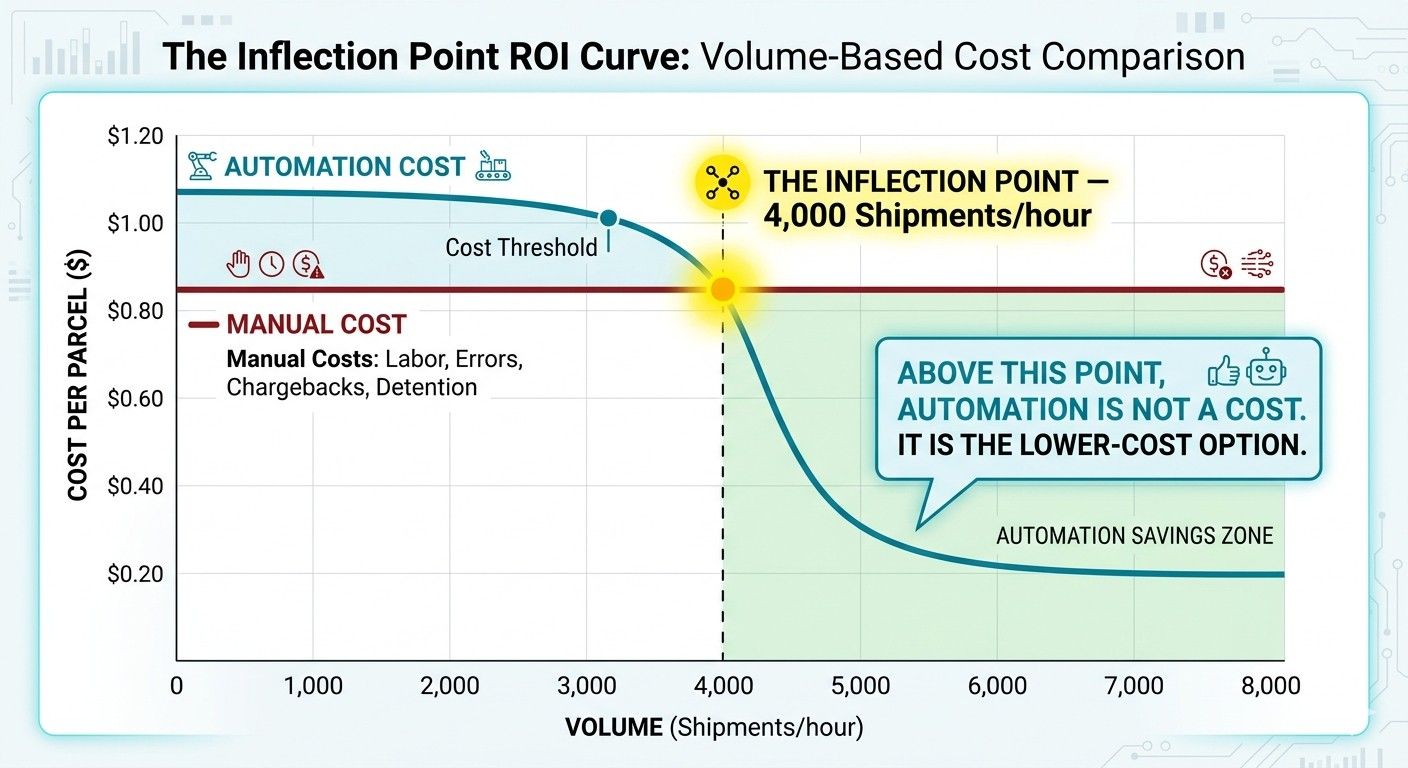
There is a specific volume threshold above which manual sortation becomes structurally more expensive per unit than automated sortation.
To better understand this, let us use a case from one of our clients:
In a facility, the threshold above which manual sortation would have become structurally more expensive compared to automated sortation was 4,000 shipments per hour.
Below 4,000 shipments per hour, adding manual tables works.
More operators, more stations, more throughput. The math still moves in the right direction.
There is friction, but it is manageable . Above 4,000 shipments per hour, there’s a shift: The floor runs out of efficient travel paths. Operators who need to move between weighing stations and dispatch cages are now navigating a floor that is simultaneously being used by others doing the same thing.
Adding another operator does little to nothing. And it is not their fault either! It’s just that the floor has reached its limit.
Walking time, collision avoidance, and queue formation at terminals- these absorb the productivity gain before it can reach the manifest.
It is now that the real cost of manual logistics automation failures starts to show up.
The ROI inflection point is the moment when the cost of manual errors like mis-billing, DIM under-declaration, shipping chargebacks, and vehicle detention charges exceeds the monthly cost of operating an automated system.
With our clients, the inflection point happened to arrive before the facility crossed 4,000 shipments per hour consistently.
The DIM under-declaration liability alone, compounded across the 6,500-per-hour peak, justifies the investment before labour savings are even factored in.
This is the argument most ROI calculators miss. They model headcount reduction. They don’t model what the 9% peak error rate is doing to carrier invoicing every single month.
How Automation Improves Warehouse Operations: The Hybrid Sortation System in the "After" State
See a Quinta DWS + Linear Sorter system in action
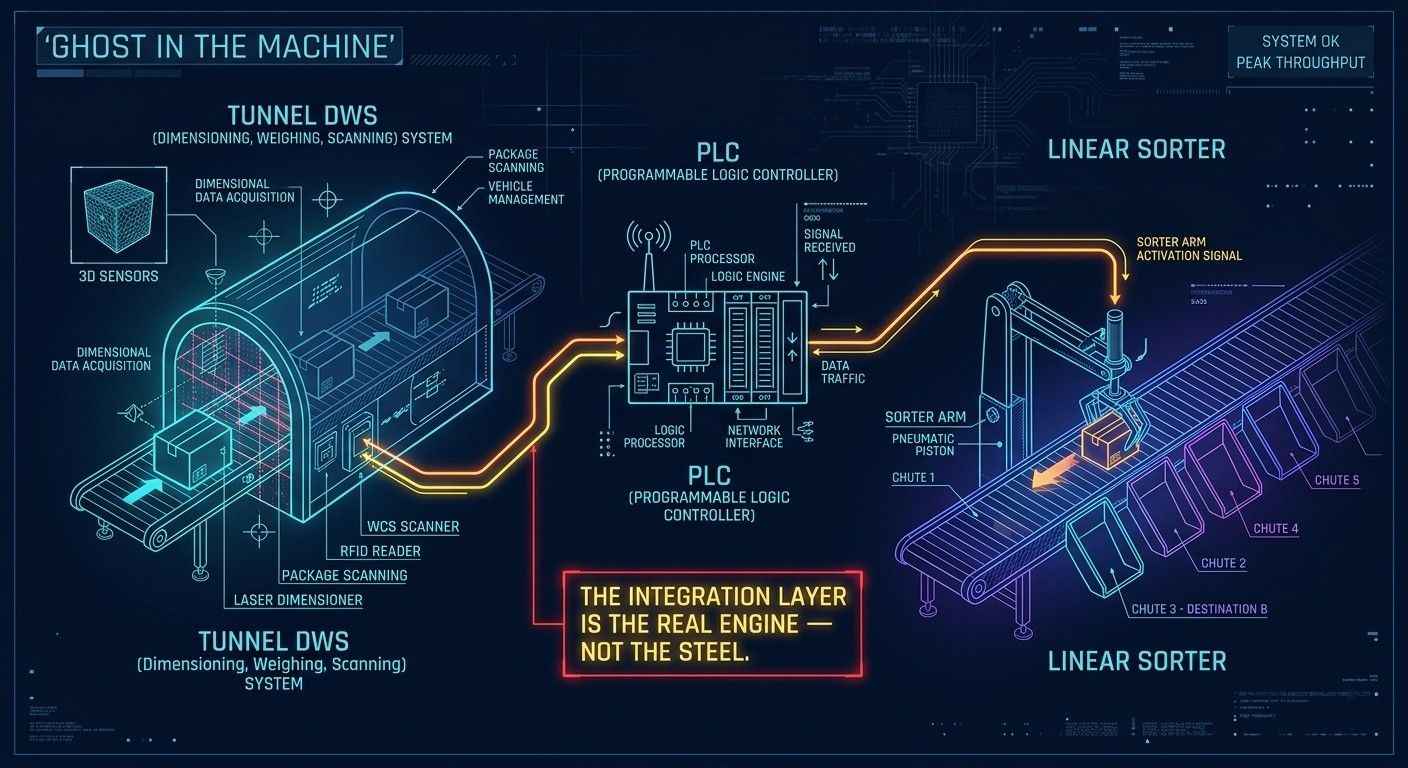
The “After” state in this simulation is not a replacement for the “Before” state.
It is a different architecture entirely.
We deployed a Hybrid Linear Sortation System integrated with a High-Speed Tunnel DWS for the facility.
Let us tell you how it went down:
A parcel enters the induction belt. It does not stop.
The tunnel DWS System for ecommerce warehouses, a high-speed on-the-fly measurement system, captures the parcel’s length, width, height, and weight as it moves through at belt speed.
Simultaneously, the integrated scanner reads the barcode.
All three data points: dimensions, weight, and barcode are captured in the same pass, without human input, and transmitted to the Warehouse Control System in real time.
The WCS already knows this parcel’s destination. It knows which of the four carriers it belongs to. It knows which pincode cluster the carrier’s chute corresponds to.
By the time the parcel exits the DWS System tunnel and reaches its sort point on the linear belt, the system has already made the routing decision.
The carrier belt activates.
The parcel diverts into the correct chute.
The operator who used to spend 8–10 seconds weighing, measuring, and typing is now at an induction station. Their job is to place parcels onto the belt at a consistent rate and flag any parcel the system rejects — a “No-Read,” typically caused by a damaged or smudged barcode.
This is the data latency problem, solved.
The manifest closed at 4:43 PM. The carriers arrived at a ready dock.
Scale Elasticity: What 135,000 Shipments in a Day Actually Looks Like
If you vouch for manual operations, you will not like this:
Last year’s Diwali Sale was a spinebreaker (for manual operators).
For 10 consecutive days, the facility’s daily volume jumped from 45,000 shipments to 135,000. A 3x spike.
If you have run manual operations during the festive season, you are probably aware.
Temporary staff do not know the floor.
Supervisors stretched across double the usual stations.
Error rates that climb past peak levels before noon.
In the manual “Before” state that we discussed earlier, handling a 3x volume spike means a 3x increase in everything: operators, terminals, floor space, supervision overhead, error volume, and chargeback liability.
The cost curve scales linearly with volume, which means the festive season, which should be the most profitable ten days of the year, is also the most expensive ten days to operate.
In the hybrid automated “After” state, the same 3x spike requires additional induction capacity: more operators feeding the belt, but not more sortation infrastructure.
The throughput capacity of Linear Sorter does not change because the volume has changed.
The DWS tunnel processes the same number of parcels per minute at 135,000 shipments per day as it does at 45,000.
The error rate doesn’t climb as high because there is no manual entry to degrade under pressure.
This is what we mean by scale elasticity.
The ability to absorb a 300% volume spike without a corresponding 300% increase in cost or error rate is not a feature of the automation — it is the structural argument for it.
The ROI case for a system like this is typically modelled over 12 months of normal operations. The Diwali window alone — 10 days, 3x volume, stable error rates, no detention charges, no DIM under-declaration at peak — changes the timeline significantly.
What the "After" State Actually Costs You That the Sales Deck Won’t Mention
We want to be direct here, because this is where most automation conversations go quiet.
The transition from a manual operation to a hybrid automated system does not eliminate problems.
It reclassifies them.
And the new category of problems requires a different kind of capability to manage.
The skill gap is real.
In our cases, 70% of floor staff transition from manual weighing and sorting into induction and exception-handling roles.
The physical work: lifting, placing, and moving parcels remains.
What changes is the cognitive requirement.
These operators now need to identify “No-Reads” (parcels the system rejects because of unreadable barcodes), understand basic system alerts, and know when to escalate versus resolve independently.
This is not an insurmountable retraining challenge. But it is a retraining challenge, and it takes time.
The first two weeks of an automated operation are typically the period of highest friction in our experience.
The facility also needs to hire a Systems Reliability Engineer. This role didn’t exist in manual operations, and it is not optional. Someone needs to own the system’s uptime.
Which brings us to the most important realism in this entire blog.
In the manual “Before” state, if one scale breaks, the facility loses roughly 5% of its Dimensioning, weighing and Scanning capacity. Other stations absorb the shortfall. The system degrades gracefully.
In the automated “After” state, if the sorter’s PLC, the Programmable Logic Controller that acts as the brain of the entire sortation system, experiences a fault, the facility loses 100% of its automated sortation capacity.
Not 5%.
Not 20%.
All of it.
Every parcel on the line stops.
We are not trying to argue against automation. It is an argument for taking the maintenance contract as seriously as the hardware decision.
A Gold-Level Annual Maintenance Contract with guaranteed response times and on-site spare parts is not a line item to negotiate away during procurement.
For us, it is part of the ROI calculation from day one, because the cost of one unplanned PLC failure during a Diwali peak, measured in missed SLAs, carrier penalties, and customer refunds, exceeds the cost of the AMC for the entire year.
The “After” state is measurably better.
It is also more dependent on its infrastructure remaining intact. That dependency is the price of scale, and it needs to be planned for, not discovered.
Frequently Asked Questions
The swing-arm sorter is significantly cheaper to purchase and install. Its simple mechanical design requires fewer sensors and motors. Swivel wheel sorters cost more due to individual motorized wheels and servo controls.
DIM under-declaration occurs when a parcel's dimensions are not accurately measured and recorded, causing the billed weight to be lower than the carrier's volumetric weight calculation. In India, carriers charge the higher of actual versus volumetric weight. When manual operators skip or estimate dimensions during the 4 PM rush, the fulfilment hub ends up absorbing the difference between what it billed and what the carrier invoices — a structural revenue leakage that compounds at scale.
A static DWS requires each parcel to be placed on a stationary platform for measurement, one at a time, with a pause in the line. A tunnel DWS captures dimensions, weight, and barcode data while the parcel moves through the system at belt speed, without stopping. In high-volume operations, this distinction determines whether data capture is a bottleneck or a transparent step in the workflow.
Scale elasticity is the ability of an automated system to absorb significant volume spikes — such as a 3x festive season increase — without a corresponding increase in cost per unit or error rate. Manual operations scale linearly: 3x volume requires roughly 3x resources and produces roughly 3x errors. Automated operations absorb volume spikes at the same per-unit cost and accuracy, because the system's capacity is not determined by headcount.
The retraining timeline varies by workforce and system complexity, but the transition period — where error rates and confusion are highest — typically spans the first two to four weeks of live operation. Staff moving from manual weighing into induction and exception-handling roles need to learn system alert protocols, No-Read identification, and escalation procedures. The physical work remains; the cognitive framework around it changes.

